
The AI Consulting Framework: How Solo Consultants Move Real Business Metrics
Most AI consultants sell features while businesses quietly buy outcomes. The 10-part framework, the 4-rung service ladder, and where to start today.

Most AI consultants sell features. Businesses buy outcomes. That one gap is why most never get past a single project.
The pattern is easy to recognise once you have seen it. A consultant arrives with a demo — an agent, a chatbot, an automation — and explains what it does. The client is impressed, buys once, and never buys again, because nothing in the conversation ever connected the build to a number the business tracks.
The alternative is not better technology. It is a framework that starts from the metric and works backwards. Here is that framework — all ten pieces, plus the service ladder and the pricing that goes with it.
The short version
- Bucket = why they care. Ladder = how trust gets earned.
- Constraint = what you actually fix. Claude Code = how fast you ship it.
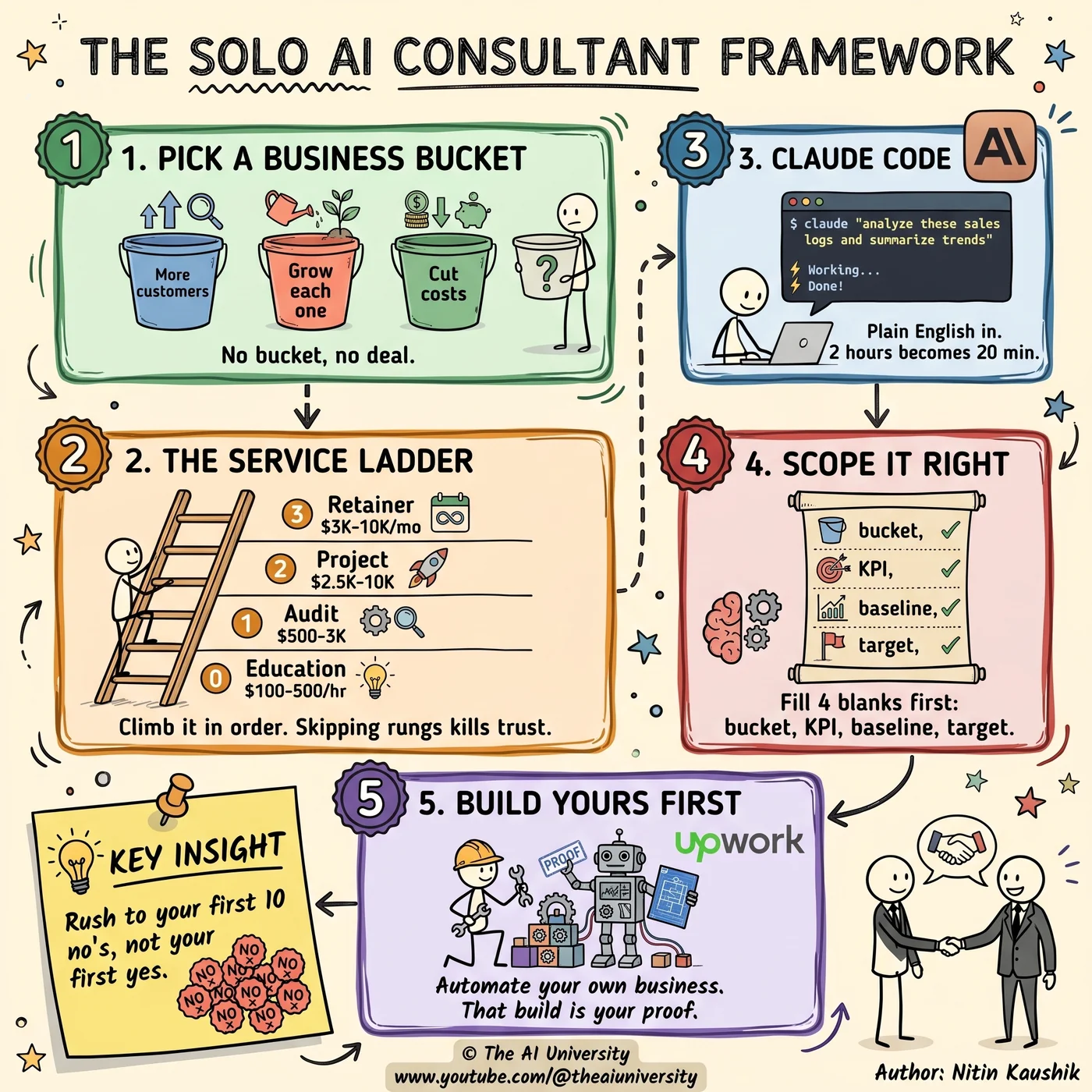
- Every project must map to one of three buckets: more customers, higher value per customer, or lower costs.
1. Pick a business bucket
Every project you take on has to target exactly one of three things:
- More customers.
- Higher value per customer.
- Lower costs.
No bucket, no deal. That rule alone kills half your bad-fit leads before you have written a proposal, which is the point — a lead that cannot articulate which bucket the work belongs in does not yet have a problem, they have an interest in AI.
It also changes the conversation. Asking “which of these three are we moving?” puts you in the position of a partner sizing a business problem rather than a vendor describing a capability.
2. Why Claude Code unlocks this
The framework has always been correct. What changed is that a single person can now execute it.
Plain English in, working build out — no computer science degree required. Work that took two hours now takes twenty minutes, and that ratio holds across most of the build surface, not just the easy parts.
The consequence for a solo consultant is that the bottleneck moves. It used to be delivery capacity; now it is problem selection and client access. Solo leverage keeps compounding, because every build you finish becomes a template for the next one.
3. The service ladder
Four rungs, and they exist to solve a trust problem rather than a pricing one.
- Rung 0 — education. Free or cheap. You teach; they learn who you are.
- Rung 1 — paid audit. A small, defined engagement that produces a document.
- Rung 2 — project. The build itself, scoped from the audit.
- Rung 3 — retainer. Ongoing responsibility for the system you built.
Start low to earn trust, then climb. Skipping rungs kills momentum every time — a cold prospect asked for a retainer says no, and the no closes the door on the rungs you could have started at.
The ladder also protects you. An audit tells you whether the client is workable before you have committed to a build.
4. Build for yourself first
Run Claude Code on your own one-person business before you sell it to anyone else.
This is not practice. It is inventory. A morning briefing automation is a portfolio. It is a real, running system with a real owner and a real outcome, and you can demonstrate it in ninety seconds.
Proof beats a pitch deck, and the asymmetry is enormous — every consultant has slides, almost none have a system they use daily that they can show working.
5. Niching
The right answer depends entirely on what you already have.
If you have industry experience: niche from day one and charge for the context. Knowing how a dental practice actually schedules, or how a law firm actually handles intake, is worth more than any technical advantage — and it cannot be acquired quickly by a competitor.
If you have no experience: stay broad and gather reps. Your first five conversations teach more than perfect targeting ever will, because they tell you which problems recur and which ones people will pay to remove. Niche after the data arrives, not before.
6. Finding clients
Three channels, in order, and the order is the important part.
- Warm outreach first — and ask for feedback, not for the sale. People who know you will tell you the truth about your offer, which is worth more at this stage than a signed contract.
- Then Upwork, for active buyers. Not glamorous, but people posting there have a budget and a deadline, which removes the two hardest parts of a cold pitch.
- Then build in public, so leads come to you. The slowest channel and the only one that keeps producing after you stop working it.
7. Sales mindset
Rush to your first 10 no’s, not your first yes.
This is a reframe rather than a tactic, and it changes behaviour immediately. If the target is ten rejections, every conversation is progress, and the fear that stops most people from having the eleventh conversation disappears.
Every no is data. You are collecting a map — of which industries respond, which framing lands, which price causes a flinch — not collecting rejection.
8. Scope projects right
The most common way a good consultant delivers a bad project is by fixing the loudest annoyance rather than the actual constraint.
Find the constraint. Then fill four blanks before you build anything:
- Bucket — which of the three?
- KPI — the specific number.
- Baseline — what it is today.
- Target — what it should be.
That discipline is what puts you in the 13% of AI projects that succeed. Without a baseline you cannot prove improvement; without a target you cannot define done. Most failed projects were never scoped, only started.
9. Pricing
Prices that match the rungs:
- Education: $100–500 per hour.
- Audit: $500–3K.
- Project: $2.5K–10K.
- Retainer: $3K–10K a month.
Predictable beats big. A retainer at the bottom of that range is worth more than an occasional project at the top of it, because it removes the recurring cost of finding the next client — which is the real expense in solo consulting.
10. Growth
Turn early wins into case studies, then niche around whatever worked. The niche should be discovered, not chosen — your first successful project tells you where you have an edge.
Three things compound from there: you ship faster on repeat builds, you speak the client’s language rather than a technical one, and you raise your rate because both of the first two are visible to the buyer.
The master formula
- Bucket = why they care.
- Ladder = how trust gets earned.
- Constraint = what you actually fix.
- Claude Code = how fast you ship it.
Stop trying to be a jack-of-all-AI. Be the partner who moves the metric.
Frequently asked questions
How do you start AI consulting with no clients?
Build for yourself first — run Claude Code on your own one-person business so you have a real system to demonstrate. Then warm outreach asking for feedback rather than the sale, then Upwork for active buyers, then build in public so leads arrive on their own.
How should AI consulting be priced?
By rung. Education runs $100–500 per hour, a paid audit $500–3K, a project $2.5K–10K, and a retainer $3K–10K a month. Predictable beats big: a modest retainer removes the recurring cost of finding the next client.
What is the service ladder and why not skip rungs?
Rung 0 is education, rung 1 a paid audit, rung 2 a project, rung 3 a retainer. It is a trust sequence, not a price list — a cold prospect asked for a retainer says no, and that no closes the rungs you could have started at.
How do you scope an AI project so it actually succeeds?
Find the real constraint rather than the loudest annoyance, then fill four blanks before building: bucket, KPI, baseline and target. That discipline is what puts a project in the 13% that succeed — without a baseline there is no proof of improvement, and without a target there is no definition of done.
Should a new AI consultant niche immediately?
Only if you already have industry experience — in that case niche from day one and charge for the context. With no experience, stay broad and gather reps; the first five conversations teach more than perfect targeting, and the niche should be discovered from what actually worked.
Build it yourself
Everything written about here gets built in the open — the whole application, on camera, including the parts that did not work first time.
Keep reading
 AI agent skills
AI Agent Skills: 9 Free Ones and the Step Most Skip
AI agent skills install from one pasted link — that part is easy. The step that makes them genuinely useful is the one almost nobody runs.
Read article→ Jev decision model
Jev Decision Model: The AI That Can't Write, Only Decides
The Jev decision model can't write a word. Vercel and LangChain added it anyway. Why a "System One" classifier is 200x faster than the LLM in your agent.
Read article→ open source SaaS alternatives
Open Source SaaS Alternatives: 5 Repos Worth Selling
Semrush charges $250. This costs ten.
Read article→