
Open Source SaaS Alternatives: 5 Repos Worth Selling
Semrush charges $250. This costs ten.

An open source SaaS alternative is a freely licensed application that does the job of a paid subscription tool, hosted by you instead of rented from a vendor. The category is not new. What changed is the setup cost: repositories that once demanded a week of configuration now install in an afternoon, and a coding agent can carry the parts you cannot. That shift turns a cost saving into something sellable, because the tool it replaces already carries a public price, and that published number is the ceiling you price against.
Why open source SaaS alternatives are suddenly worth selling
Open source SaaS alternatives became sellable the moment the work of standing one up fell below the value of the outcome it produces. A small business does not want a repository. It wants a weekly report, a chatbot its new hires can query, or a proposal on the same day rather than the same week. The repository is how you deliver that cheaply; the outcome is what appears on the invoice.
This also resolves the awkward question of what a non-technical operator is actually charging for. Not software — the software is free and the buyer could download it too. You are charging for installation, hosting, judgement, and the fact that they will never do it themselves.
What you are selling is an outcome, not AI
Selling the outcome rather than the technology is the difference between a sale and a debate about AI. "I will run a scraper for you" invites scepticism. "You will know within minutes when a competitor cuts a price or sells out" is a business result with an obvious value, and the buyer never needs to know which framework produced it.
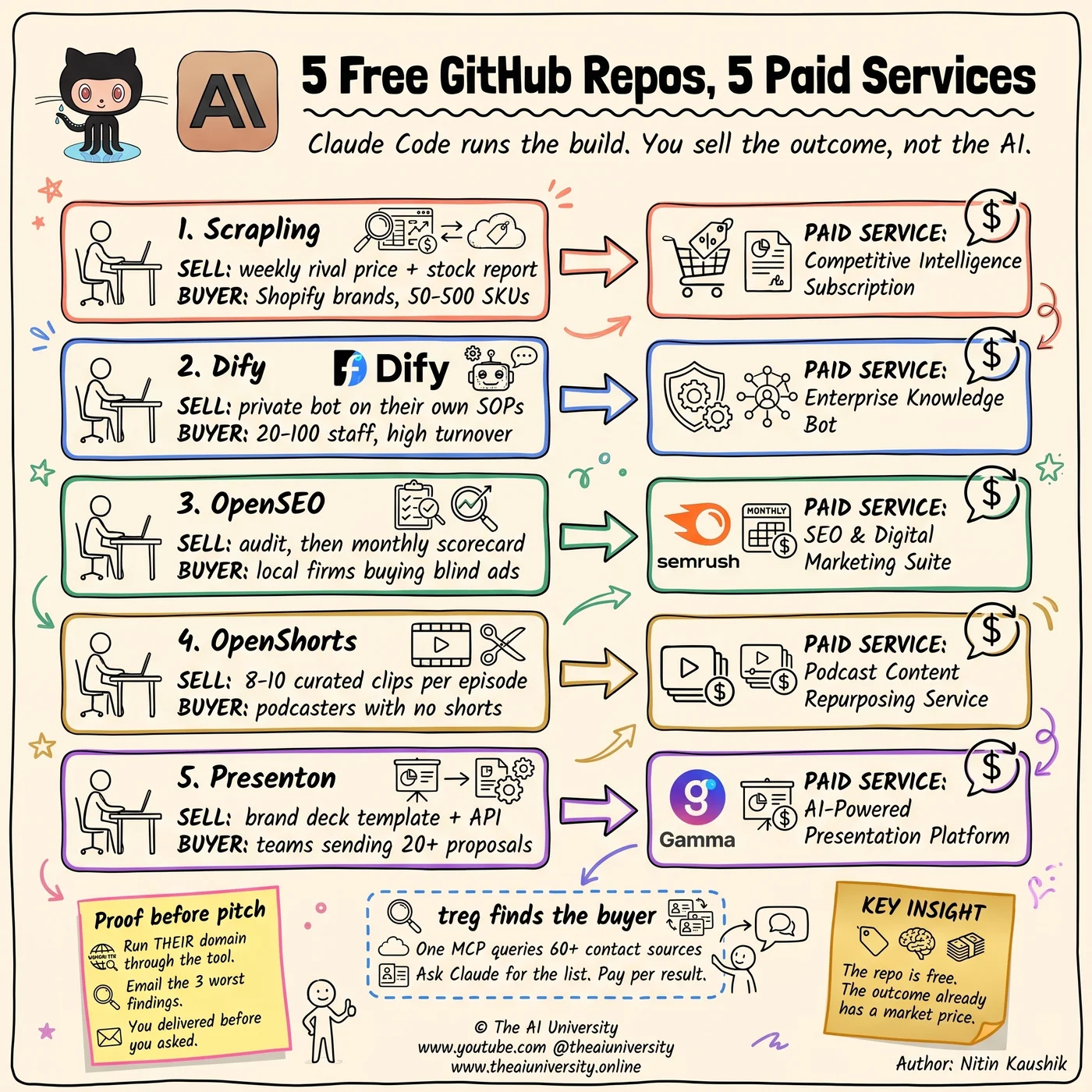
Each of the five repositories below maps to one outcome, one buyer profile and one honest price. The pattern is identical every time: a free engine, a coding agent running it, and a paid tool nearby whose public rate tells you what the market already accepts.
Scrapling: selling competitor price monitoring to ecommerce brands
Scrapling is an adaptive web scraping framework that gets past bot walls and keeps working when a target site changes its markup. Site redesigns are what historically broke scraping services and turned a recurring product into recurring repair work, so an adaptive parser is what makes this saleable as a subscription rather than a project.
The service is a weekly competitor price and stock intelligence report. You scrape five of a client's named rivals, land the results in a spreadsheet, and alert them whenever a price drops or an item goes out of stock. The buyer learns within minutes rather than at the end of the month, which is early enough to reprice and keep the sale.
Who buys competitor price monitoring
Shopify and DTC brand owners carrying roughly 50 to 500 products, doing $1 million to $10 million a year, with at least three to five named competitors they already worry about. Fewer products and the owner watches rivals manually; no named competitors and there is nothing to monitor.
A workable structure is a $500 setup fee and $300 a month to maintain it, against roughly $40 a month in proxies and a small server.
GitHub Link: https://github.com/D4Vinci/Scrapling
Dify: why companies pay for a self-hosted AI chatbot
Dify is an open source platform for building production AI applications, and it is among the most-starred agent frameworks on GitHub. The service you sell on top of it is a private chatbot trained on one company's own SOPs, staff handbook and price sheets, refreshed monthly as those documents change.
The value is onboarding speed. New hires query the bot and get an answer in seconds instead of interrupting the owner or their manager, which compresses onboarding from weeks toward days. The monthly refresh is what makes it recurring rather than a one-off build — processes change, and a stale handbook bot is worse than none at all.
Why not just use a public chatbot
Most firms will not upload internal documentation to a public model, and that single objection is the whole reason this service exists. A self-hosted AI chatbot keeps the handbook inside infrastructure the client controls. Dify Cloud starts around $59 a month for a hosted instance, and one instance per client can be billed straight through.
The buyers are service businesses with 20 to 100 employees and genuine turnover — home services, property management, insurance and staffing firms, all constantly onboarding. A $1,500 setup fee plus $250 a month is a defensible structure.
GitHub Link: https://github.com/langgenius/dify
OpenSEO: the open source SaaS alternative to a $250 SEO tool
OpenSEO is an open source alternative to Semrush and Ahrefs covering keyword research, rank tracking, backlinks, site audits, Google Business Profile checks and visibility inside AI search engines. Semrush's comparable tier lists around $250 a month. Self-hosted, OpenSEO runs on roughly $10 a month in hosting.
That gap makes it the most beginner-friendly of the five, because the AI visibility feature lands on a question every local business is currently asking and almost none can answer: whether they get mentioned when someone asks an AI assistant for a recommendation.
What the monthly deliverable actually contains
A two-page scorecard: 30 keyword rankings, actual Google clicks, the client's top three competitors, a Google Business Profile audit and three recommended fixes. Sell a $499 audit as the way in, then $199 a month for the scorecard — less than the client would pay to license Semrush themselves, with someone reading it for them.
The buyers are local service businesses already spending on SEO or on Google and Meta ads without strong reporting behind it: dentists, law firms, HVAC companies, med spas.
GitHub Link: https://github.com/every-app/open-seo
OpenShorts: what an AI video clip generator is worth as a service
OpenShorts is an open source AI video clip generator — the self-hostable counterpart to Opus Clip. It picks the strongest moment in a long video, cuts a vertical clip, adds captions, and costs pennies per run.
The obvious objection is that the client could subscribe to Opus Clip for $29 a month. They could, and they will not, because they are not clipping their long-form content today and have shown no interest in learning an editing tool. What you sell is 8 to 10 curated captioned clips per episode, hooks written by you, scheduled to TikTok, Reels and Shorts — roughly 30 to 40 shorts a month out of recording they already do. Around $400 a month for four episodes is a fair rate for about three hours of work.
The buyers are experts already producing long-form and publishing no clips: realtors, advisers, lawyers, coaches and podcast hosts.
GitHub Link: https://github.com/mutonby/openshorts
Presenton: how an AI proposal generator shortens a sales cycle
Presenton is an open source AI proposal generator and presentation builder positioned against Gamma, Canva and Beautiful AI, with over 10,000 GitHub stars and, critically, an API. It turns a form or a document into an editable PowerPoint locked to a brand template.
The API is what makes this a service rather than a tool recommendation. You build the client's brand deck as a template plus a form, so a rep fills in a few fields and a branded proposal appears; or you wire an automation that takes the call recording and generates the proposal from it.
The outcome is a same-day proposal instead of a two or three day wait on marketing, every deck on brand, no designer in the loop. Gamma lists around $400 a month for ten seats. A $2,500 setup fee plus $200 a month for hosting and template fixes sits well under that, and the higher setup is justified because faster quotes close faster.
The buyers are sales teams sending 20 or more custom proposals a month: contractors, agencies, staffing firms, events companies and commercial real estate.
GitHub Link: https://github.com/presenton/presenton
Productized service pricing: what each one costs to run
Productized service pricing works backwards from the published rate of the tool you displace, not forwards from your hours. The table below is the whole argument in one view.
Repo | Stands in for | That tool's public rate | Your running cost |
|---|---|---|---|
Scrapling | custom scraper builds | project pricing | ~$40/mo proxies and a small server |
Dify | a public LLM chatbot | not an option for internal docs | Dify Cloud from $59/mo per instance |
OpenSEO | Semrush | ~$250/mo | ~$10/mo hosting |
OpenShorts | Opus Clip | $29/mo | pennies per run |
Presenton | Gamma | ~$400/mo for 10 seats | self-hosted |
One honest correction to the word "free". Free is the licence, not the running cost. Proxies, servers, a hosted instance and your own upkeep are all real, and the right-hand column is what you are spending before anyone pays you.
How to find the buyer without five data subscriptions
Finding the buyer is the step that stops most people, and it is the step a single MCP connection now collapses. treg is a people-search service that queries more than 60 contact providers through one Model Context Protocol connection and charges per result, which removes the need to hold Apollo, Hunter and People Data Labs subscriptions simultaneously just to run a few hundred lookups.
Connected to Claude Code, it becomes a text prompt: companies on Shopify with 5 to 50 employees in the US, titles of founder, owner or ecommerce manager, verified emails. The filters change per offer. For the Dify service you search job postings instead, because a company with three or more open roles is onboarding right now and has the pain today. For OpenShorts you look for firms hiring short-form editors, or podcasts with 20-plus episodes and no clips.
Proof before pitch: the step that actually closes
Running the tool on the prospect before contacting them is what separates this from ordinary cold email. Because the repository costs almost nothing per run, you can afford to do the work first and send the result, unrequested.
For OpenSEO that means putting their domain through an audit and leading the email with their three worst findings and the real numbers behind them. For OpenShorts it means sending three finished clips cut from their latest episode. For Presenton it means asking for their last proposal and rebuilding it, on brand, while they watch. Once a prospect has seen a specific finding about their own business, you have earned the right to pitch, and you are no longer arguing about whether AI works.
The bigger shift
The thing worth taking from all five is not the repository list, which will look different in a year. It is that the cost of delivering a software outcome has detached from the price the market pays for it, and the published rate of the incumbent tool is now a ceiling rather than a benchmark you have to beat on features.
That gap is not permanent and it is not a secret. It is open on GitHub. The scarce parts are knowing which outcome a specific business will pay for, and being willing to do the work before you ask for the order.
Frequently asked questions
What is an open source SaaS alternative?
An open source SaaS alternative is a freely licensed application that performs the job of a paid subscription product, run on infrastructure you control rather than rented from a vendor. OpenSEO standing in for Semrush is a clear example: the same categories of work, keyword tracking and site audits, at hosting cost instead of a monthly licence. The licence is free; hosting, maintenance and your own time are not.
Do you need to know how to code to sell these services?
No, you do not need to write code to sell these services, because a coding agent handles the installation and the wiring while you handle the client. Claude Code can stand up the repository, connect it to a spreadsheet or a scheduler, and keep it running. What you genuinely need is judgement about which outcome a business will pay for, and enough familiarity to recognise when the output is wrong.
How is this different from reselling a software subscription?
Reselling a subscription means passing on someone else's licence at a markup, which caps the margin and makes you replaceable the moment the client finds the vendor. Running an open source SaaS alternative means you own the delivery: the setup, the hosting, the curation and the monthly deliverable. The client is buying a report, a bot or a finished set of clips, not access to a tool they could sign up for directly.
What does it cost to run one of these services?
Running costs range from a few dollars a month to about sixty, depending on the repository. OpenSEO self-hosts on roughly $10 a month, a Scrapling service needs around $40 a month for proxies and a small server, and Dify Cloud starts near $59 a month per instance, which can be billed to the client. OpenShorts costs pennies per run. Your own time is the larger line item.
What does Dify do that a public AI chatbot cannot?
Dify lets a company keep its internal documents inside infrastructure it controls, which is the specific objection that stops most firms using a public chatbot for their handbook. SOPs, price sheets and staff policies are exactly the material a business is unwilling to upload to an external model. Self-hosting removes that objection, and the monthly refresh keeps the answers current as the underlying documents change.
Build it yourself
Everything written about here gets built in the open — the whole application, on camera, including the parts that did not work first time.
Keep reading
 Claude AI side hustles
Claude AI Side Hustles: 5 That Fit Around a Full-Time Job
Claude AI side hustles work because your job already gave you the niche. Five that fit around full-time work, and the one thing that decides all five.
Read article→ agentic AI system design
Agentic AI System Design: 9 Layers That Break in Production
Agentic AI system design is backend engineering, not prompting. The nine layers that decide whether your agent survives production.
Read article→ Model Context Protocol
Model Context Protocol: What It Is and Why It Matters
Model Context Protocol exists because your AI agent still cannot call an API. Here is the exact division of labor between the model, the client, and the server.
Read article→