
Model Context Protocol: What It Is and Why It Matters
Model Context Protocol exists because your AI agent still cannot call an API. Here is the exact division of labor between the model, the client, and the server.
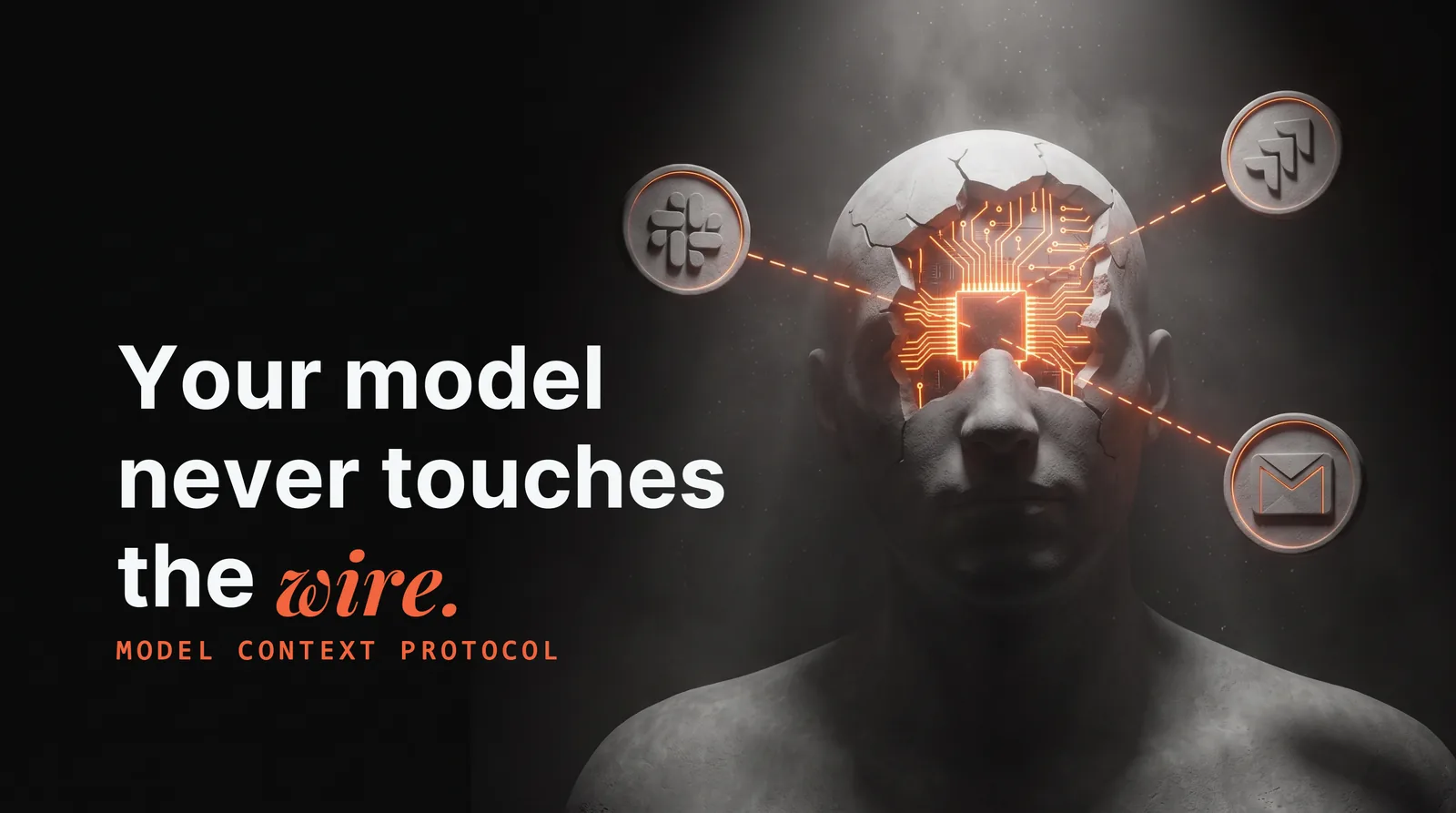
Model Context Protocol is the standard that lets an AI model request an action without your application writing a one-off integration for every service it touches. Most conversations about AI agents skip a detail that matters more than it sounds: the model itself never makes an API call. It decides what should happen — send a message, create a ticket, look something up — and hands that decision to your application's code, which does the actual work of authenticating, formatting the request, and calling the service. That distinction is the whole reason Model Context Protocol exists, and understanding it explains why teams building more than one AI app eventually reach for it.
What Model Context Protocol Actually Is
Model Context Protocol is a way of standardizing how an AI application's execution layer talks to the services it depends on, instead of each app writing its own private wiring to Slack, Gmail, or Jira. An API — an application programming interface — is simply how two pieces of software talk to each other; your app calling Slack's message endpoint is one ordinary example. Handling one service, one app, and every scenario yourself is manageable. The moment an app needs ten services, someone still has to write ten integrations, plus the authentication, error handling, retries, and calling logic behind each one.
Adding a large language model to decide when those calls happen does not remove that work. The model still cannot call an API itself — it only tells the application what it wants done, and the application's code carries out the call. The ten integrations still get written. The model just decides when each one fires.
The API Integration Problem It Solves
AI agent API integration becomes expensive the moment a second application enters the picture. A team that already wrote integrations for Slack, Gmail, and Jira for one app has to write the same ten integrations again for the next app that needs the same services — full authentication, error handling, and retry logic included, rebuilt from nothing. Multiply that by every additional app an organization builds, and the result is piles of duplicated integration code spread across teams, each version drifting slightly as it gets patched and extended on its own.
Model Context Protocol exists specifically to stop that duplication:
Approach | 2 apps needing 10 services |
|---|---|
Direct integration, written per app | 20 separate, repeated integrations |
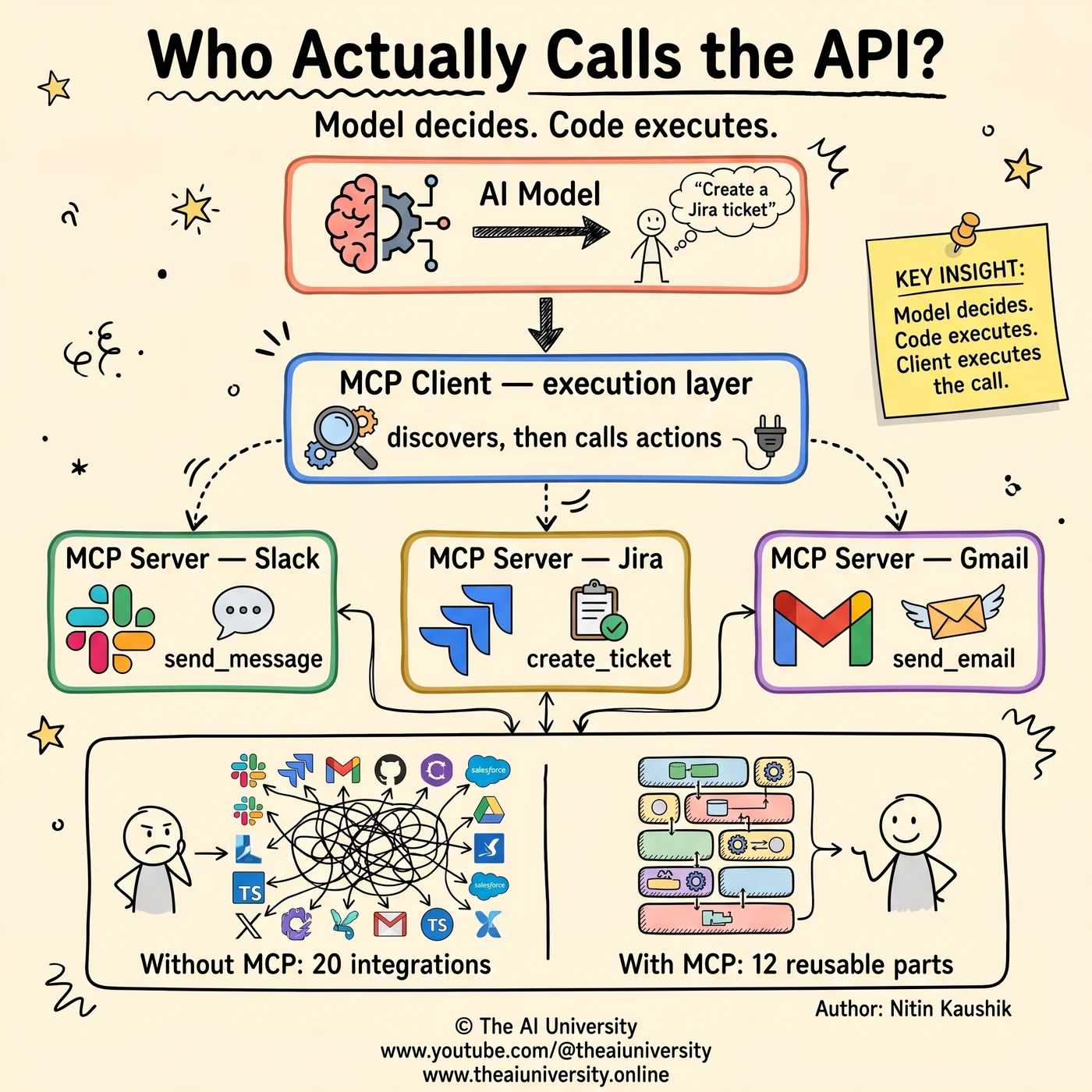
Model Context Protocol | 12 reusable components |
Model Context Protocol reduces the naive setup to twelve reusable pieces because the integration work is written once, next to the service, and shared by every app that needs it — instead of once per app.
How MCP Servers and Clients Work Together
MCP servers and clients split the execution layer into two reusable pieces instead of one custom build per app. An MCP server sits next to a service — Slack, Gmail, Jira, a database, or anything else an application needs to reach — and exposes a standard, labeled set of actions that service supports. An MCP client sits inside the AI application itself and speaks that same standard language to request those actions.
Because the server and the language are both standardized, a second application that needs Slack does not need a second Slack integration. It needs an MCP client that already knows how to talk to any MCP server, including the one already sitting next to Slack. This is also why maintenance gets simpler: when a service's own API changes internally — Slack updates an endpoint, for instance — only that service's MCP server needs to be fixed. The model-facing code in every application that uses it stays untouched.
How Does an AI Agent Actually Call an API With MCP?
An AI agent never calls the API directly — it picks a labeled action, and the execution layer behind it makes the actual call. Before the model picks anything, the MCP client discovers what a server can do, in a step the protocol calls discovery. The client asks each MCP server what actions it supports, and the server responds with a list of labeled options — something like "send message" or "create ticket" — rather than raw, low-level API calls.
The model then picks from that discovered list to decide what to do next. Because the options are already labeled and discovered at runtime, nobody has to hand-write a decision tree mapping every possible user request to a specific API call in advance. Raw API documentation, by contrast, is written for developers, not for models: it is verbose and granular, and a model reading it directly has to learn and chain multiple low-level calls itself. MCP servers wrap that documentation into the clean, named actions the model actually needs.
A Real Example: Automating a Support Ticket
A support application shows the full loop in one request. A customer tells the app "payment failed." The model uses the actions it already discovered to request "create Jira ticket" with the relevant details attached. The MCP client forwards that request to the Jira MCP server, which calls Jira's native API to actually create the ticket. The ticket gets created, and the model reports the result back to the customer.
At every step, the division of labor holds: the model decides what should happen, and the execution layer — the MCP client and the Jira MCP server behind it — is what actually calls the API.
What Model Context Protocol Doesn't Fix
Model Context Protocol limitations start with context size. Both MCP and loading raw API documentation directly can bloat a model's context window with more available actions than a given task actually needs. A well-built application still has to load only the actions relevant to the current request to keep that cost down — MCP does not do that filtering automatically.
Security is also still the application's job. API keys and credentials stay inside the execution layer, never exposed to the model itself, but that separation only holds if the application is built to keep it that way. And permissions and approvals — deciding which actions an agent is allowed to take without a human in the loop — still require careful setup by the development team. MCP standardizes how the execution layer talks to services; it does not remove the need to build and secure that layer well.
When to Use Model Context Protocol vs. Direct Integration
Direct integration is still the simpler choice for a single application making a small, known set of API calls — there is no standardization benefit to chase if nothing else in the organization needs the same service. Model Context Protocol earns its cost when multiple AI applications need the same underlying systems: the standardized servers and clients mean that integration work gets written once and reused, instead of rebuilt app by app.
Either path still ends at the same place. The model decides, and code executes the call. The only thing that changes is whether that execution code gets written fresh for every application, or built once and shared.
Frequently asked questions
What is Model Context Protocol?
Model Context Protocol is a standard for how an AI application's execution layer talks to outside services like Slack, Gmail, or Jira. An MCP server sits next to the service and exposes a standard set of labeled actions, and an MCP client inside the app requests those actions. The AI model still never calls the API itself — it only decides which discovered action to request.
Do I need MCP if I'm only building one AI app?
Not necessarily. For one application making a small, known set of API calls, a direct integration is simpler and carries no real downside, because there is no duplicated work to avoid yet. Model Context Protocol starts paying off once a second application needs the same services, since standardized servers and clients let that integration work be reused instead of rebuilt from scratch.
How is MCP different from just feeding API docs to the model?
Feeding raw API specs to a model works, but every application still needs its own custom execution layer to handle credentials, retries, formatting, and error handling — none of that is shared between apps. Raw API docs are also written for developers, so a model has to learn verbose, granular calls and chain them itself. MCP servers wrap the same functionality into clean, named actions instead.
How does an AI agent actually call an API with MCP?
It doesn't call the API directly. The model requests a labeled action, like "create Jira ticket," that it already discovered from an MCP server. The MCP client inside the app forwards that request to the right MCP server, which calls the service's native API on the model's behalf, then reports the result back to the model.
Can MCP work with Slack, Gmail, and Jira?
Yes — those are the exact services used as the running example: an MCP server can sit next to Slack, Gmail, or Jira and expose actions like sending a message, sending an email, or creating a ticket. Model Context Protocol isn't limited to web APIs either; it can also wrap databases, local files, and terminal commands.
Build it yourself
Everything written about here gets built in the open. The community on Skool is where the source, the prompts and the questions live.
Join the community →Keep reading
 Claude AI side hustles
Claude AI Side Hustles: 5 That Fit Around a Full-Time Job
Claude AI side hustles work because your job already gave you the niche. Five that fit around full-time work, and the one thing that decides all five.
Read article→ agentic AI system design
Agentic AI System Design: 9 Layers That Break in Production
Agentic AI system design is backend engineering, not prompting. The nine layers that decide whether your agent survives production.
Read article→ agent harnessing
Agent Harnessing: Why AI Agents Fail on Long Tasks
Agent harnessing is why long AI tasks finally finish. The fix isn't a bigger context window — it's a loop that never needs to remember.
Read article→