
Reverse Engineer Anything: Claude Can Now Rebuild Any App
Reverse Engineer Anything lets Claude look inside apps it has no code for. Here's how it works, who should skip it, and the software moat a copy can't take.

Reverse Engineer Anything, usually shortened to REA, is a free add-on that lets an AI coding agent such as Claude Code look inside an app you don't have the code for, work out how it behaves, and help you build a similar feature from scratch. The repo sat almost unnoticed for six months, then went from roughly 13,000 GitHub stars to more than 149,000 in five days. This guide covers how it works, who should use it, and the question it forces on anyone who sells software: if anyone can copy an app, what will customers still pay for?
Why the REA GitHub repo exploded in five days
The REA repo exploded because it arrived the same week Claude was used to build free copies of Photoshop and six other Adobe apps. People were already asking how far AI could go at copying software, and REA showed up with an answer. One post on X put it in two sentences: "We spent years teaching AI to write software. Now we're teaching it to take software apart."
Stars versus real installs
A fair objection on X is that many GitHub stars are people saving a repo for later, not using it. The download numbers answer that. In September, REA's install package was downloaded about 100 times a week; last week it was downloaded 128,470 times. People aren't just bookmarking REA, they are installing it.
What Reverse Engineer Anything does as an AI reverse engineering tool
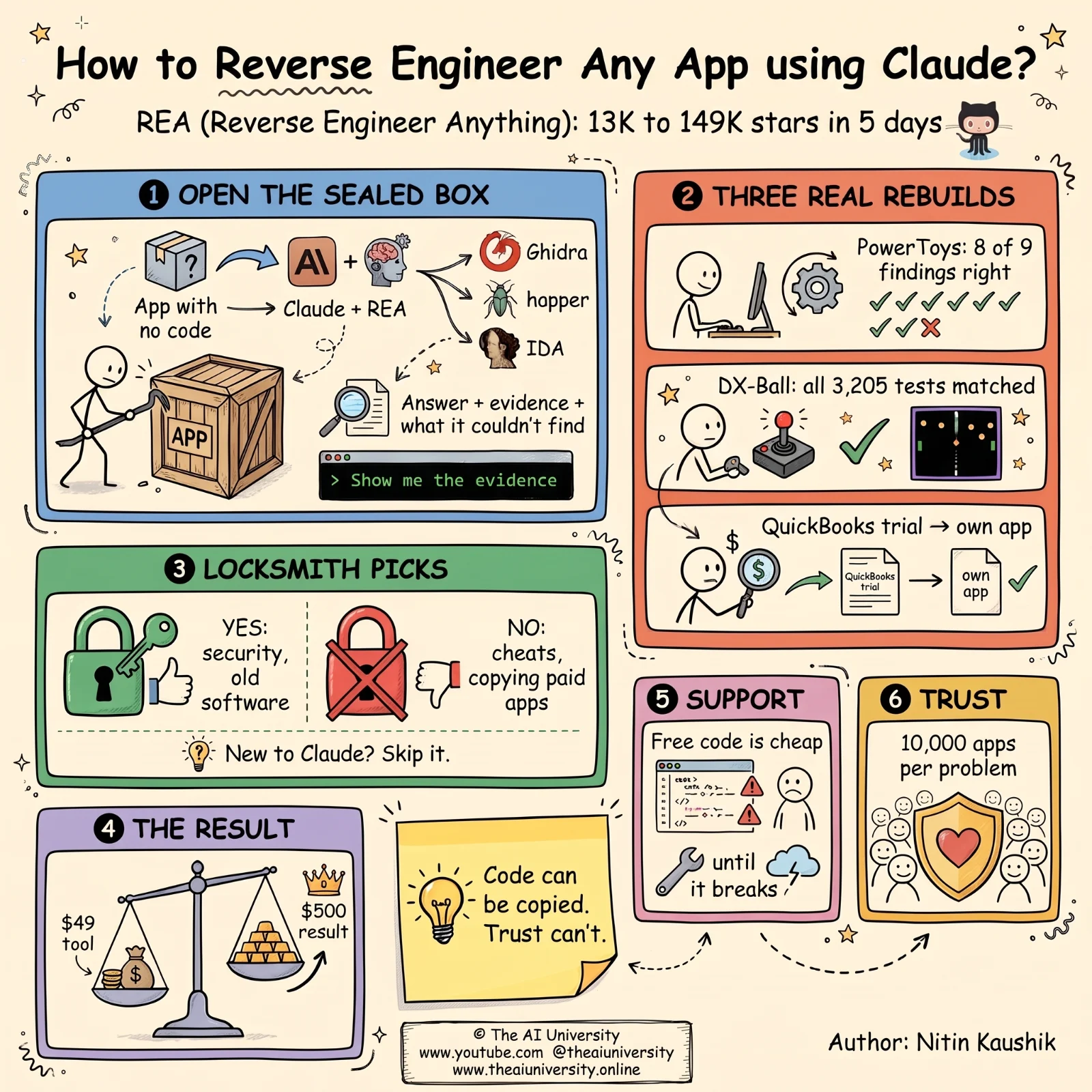
REA is an AI reverse engineering tool that hands a sealed app to your coding agent so the agent can open it and see how it works. Every app on your computer is a sealed box: Photoshop, Notion, the game you played as a kid. You get the box, never the code inside it, and opening it used to take a specialist and a lot of patience.
REA works with Claude Code, Codex, Cursor, Gemini CLI and a few other agents. It plugs in through MCP (the Model Context Protocol), which is simply a way to give Claude new tools.
How to install REA in Claude Code
Installing REA takes three steps:
Paste the REA GitHub link into Claude Code
Repo Link: https://github.com/morluto/rea
Say "Install this for me." Claude sets it up.
Restart Claude Code.
Before installing, paste the same link and ask Claude what the repo does and how you could use it.
What REA can look inside
REA is not limited to desktop apps. The repo lists websites, Android apps, the code inside devices, and even crash reports as targets.
How reverse engineering with Claude works under the hood
Reverse engineering with Claude works by letting Claude drive the same decompilers human specialists use, then report what it found along with the proof. When a company ships an app, its code is turned into machine code, the ones and zeros a computer runs. Humans can't read it, so other programs turn it back into something a person can: the big three are Ghidra, Hopper and IDA. Ghidra is free, and it was built by the NSA.
REA lets Claude operate those programs for you. Claude asks a question, REA digs into the app, and the answer comes back with the exact spots in the app that prove it, so you know Claude isn't guessing. REA also tells you what it couldn't figure out.
The chef analogy
Normal coding with Claude is cooking from a recipe card: you have the formula, so you can make the dish. REA is the chef who works out the entire recipe, and every ingredient, from a single bite.
The prompt from REA's own repo
The example prompt in the REA repo is short:
Understand how search works in the notes app. Show me the evidence and build a similar feature for my project.
Swap "notes" for any app and "search" for any feature. The final sentence, build a similar feature for my project, is the line that got everyone talking. Give Claude screenshots of the feature, or tell it to open the app and look for itself: the more Claude can see, the better it does.
Three real things people rebuilt with REA
Three real projects show how far REA goes: a Windows utility checked against public code, a 1990s game rebuilt test-for-test, and a paid accounting app studied through its free trial.
Target | What it is | What REA was used for | Result |
|---|---|---|---|
PowerToys Color Picker | Part of Microsoft's free toolkit for Windows | Analysing the finished app only | 8 of 9 findings fully right; a new color picker in under 750 lines of code |
DX-Ball | A brick-breaker game from the 1990s | Finding the math that pans sound left to right as the ball moves | The rebuilt math matched the original in all 3,205 tests, down to the exact byte |
QuickBooks | A paid accounting app | Studying the app through its trial | A separate open-source accounting app with invoices, bank imports and reports |
Why these results are credible
Two details separate these results from hype. PowerToys was a test with an answer key: Microsoft's code for it is public, so every REA finding could be checked against what Microsoft actually built. And the QuickBooks developer is candid that REA didn't hand over the original code or a finished product in one step; it took real work. Still, a 1990s game rebuilt without its code, and one person building their own version of a paid app worth billions, are why REA stopped people scrolling. The QuickBooks project also sits in a legal gray area, covered next.
Should you install Reverse Engineer Anything? Who it is for, and who should skip it
Reverse Engineer Anything is built for security work, legacy software and learning, and most beginners should skip it for now. Think of it like a locksmith's set of picks: owning one is legal, and what you open with it is the part that matters.
REA's makers are clear about the line. The tool is for:
Security work and research
Learning how software works
Making your own app work with other apps
Saving old software
Checking software you own
Their own rules say they won't help you break copy protection, build game cheats, or copy someone else's paid software.
Where the legal gray area starts
The QuickBooks project sits right in the gray area. Studying how an app works is one thing; copying it is another; and trying to sell your own copy of someone else's product is a major red flag. Reverse engineering an app can also break its license agreement, depending on where you live and what you agreed to. None of this is legal advice: for a business, ask a lawyer.
Who should install it
Security professionals. REA was built for you.
Teams running an old tool nobody has the code for any more.
Builders who want to understand how a feature works so they can build their own version.
Who should skip it
If you haven't shipped your first project with Claude yet, skip REA for now. The deep analysis needs extra programs such as Hopper or Ghidra, and it gets technical fast. For most people, the tool matters less than what it means for the apps they build.
Can you copy an app with AI? What ArtCraft and REA show together
Together, ArtCraft and REA show that Claude can now rebuild an app from the outside and inspect one from the inside, which leaves very little of an app hidden.
With ArtCraft, an engineer used Claude to build free, open-source copies of seven Adobe apps, including Photoshop, Premiere and Lightroom. The Photoshop copy alone collected over 24,000 GitHub stars in 8 days. The team never touched Adobe's code: they rebuilt every app from public documents and by studying how Adobe's apps look and behave.
Put the two repos side by side:
ArtCraft never opened Adobe's sealed box. It rebuilt the apps from the outside.
REA opens the box and looks inside, all the way down to the machine code.
Are the copies as good as the real thing? Not yet. ArtCraft's own team says its Photoshop copy isn't ready for daily professional work. But the cost of copying an app has dropped like a rock, and it keeps dropping.
What people still pay for when anyone can copy software: the new software moat
When anyone can copy software, people still pay for three things: the result, someone who answers when it breaks, and the people who already trust them. None of the three lives in the code, which is exactly why a copy can't take them. A moat is the thing that keeps competitors from copying you, and these three are where the software moat now sits.
1. The result
Picture two products built on the exact same code. One is a $49-a-month app that helps you write LinkedIn posts. The other is $500 a month and books sales calls for you from LinkedIn. Same code, ten times the price. The first sells a tool, and anyone with Claude can copy a tool. The second sells a result, which needs someone who knows what works, keeps tuning it and stands behind it. The closer you get to the money your customer actually wants, the harder you are to copy.
Phones made taking a photo free, but wedding photographers still charge thousands, because couples pay for the day to be captured right by someone they trust.
2. Someone who answers when it breaks
Say you run a business doing $2 million a year. You could run your books on a free accounting app a stranger rebuilt from a trial, or pay for the real one, with backup support and a phone number. Your numbers come out wrong the week your taxes are due. Which one do you want? Free code is cheap until it breaks; then it is the most expensive thing you own.
3. The people who already trust you
When anyone can build an app in a weekend, there won't be 10 apps for every problem. There will be 10,000. The hard part stops being building the thing and becomes getting anyone to care. Whoever already has an audience, a community or a list of customers who trust them can build something on Monday and have buyers by Friday. Someone could copy everything you have made. They can't copy the people who already know you.
Is software dead? The moat test for your product
Software isn't dead, but the part of an app's price that came from "this was hard to build" is going away. The result, the support, the trust behind an app, and your ability to get traffic and win customers are all getting more valuable every month. REA and ArtCraft didn't create that shift; they made it impossible to ignore.
The practical response is a single question about whatever you sell: if someone copied my product perfectly tomorrow, why would my customers stay? Whatever your answer is, that's your moat. Write it down in one sentence, then check the product against the three things people still pay for:
Result: can your customers point to a real outcome, like more sales or hours saved every week?
Support: if something breaks, do they know they can reach you and get it fixed?
Trust and reach: do people already know and trust you, and do you have a way to get in front of new customers?
Every yes is part of your moat. Find the one that's a no and spend this week fixing it. If you can't answer the question at all, start by giving customers a reason to stay: answer their messages the same day, know their business inside and out, be someone they like working with. None of those have anything to do with your code, and none of them can be reverse engineered.
Frequently asked questions
What is the REA GitHub repo everyone is talking about?
The REA GitHub repo is Reverse Engineer Anything, a free add-on that lets AI coding agents such as Claude Code, Codex, Cursor and Gemini CLI look inside apps without their source code. It connects through MCP and lets the agent drive decompilers like Ghidra, Hopper and IDA. The repo was about six months old when it jumped from roughly 13,000 to 149,000 stars in five days.
Do I need to know how to code to use REA?
REA is not a beginner tool, even though installing it only takes asking Claude Code to set it up. The deep analysis needs extra programs such as Hopper or Ghidra, and the work gets technical fast. If you haven't shipped your first project with Claude yet, skip REA for now; it suits security work, legacy software and learning how a specific feature works.
How is REA different from ArtCraft's copies of Adobe apps?
REA and ArtCraft copy software from opposite directions. ArtCraft's team used Claude to rebuild seven Adobe apps, including Photoshop, entirely from the outside, using public documents and the way the apps look and behave, without touching Adobe's code. REA opens an app's sealed box and inspects it from the inside, down to the machine code, which is why the two together leave so little of an app hidden.
What do I need to install REA in Claude Code?
Installing REA in Claude Code needs only the REA GitHub link: paste it into Claude Code, say "Install this for me", and restart Claude Code once setup finishes. Before installing, it is worth pasting the same link and asking Claude what the repo does and how you could use it. Deeper analysis of compiled apps also needs a decompiler such as Ghidra, Hopper or IDA.
Is Ghidra really free, and what does it do?
Ghidra is free, and it was built by the NSA. Ghidra is one of the big three programs, alongside Hopper and IDA, that turn machine code, the ones and zeros a computer runs, back into something a human can read. REA lets Claude drive Ghidra for you, so Claude can ask a question about an app and get an answer backed by the exact spots in the app that prove it.
Is it legal to reverse engineer an app with Claude?
Whether it is legal to reverse engineer an app with Claude depends on what you open, where you live and what license you agreed to. REA's makers support security work, research, learning, interoperability, saving old software and checking software you own, and refuse to help break copy protection, build game cheats or copy paid software. Selling a copy of someone else's product is a major red flag. For business use, ask a lawyer.
Build it yourself
Everything written about here gets built in the open — the whole application, on camera, including the parts that did not work first time.
Keep reading
 AI agent skills
AI Agent Skills: 9 Free Ones and the Step Most Skip
AI agent skills install from one pasted link — that part is easy. The step that makes them genuinely useful is the one almost nobody runs.
Read article→ Jev decision model
Jev Decision Model: The AI That Can't Write, Only Decides
The Jev decision model can't write a word. Vercel and LangChain added it anyway. Why a "System One" classifier is 200x faster than the LLM in your agent.
Read article→ open source SaaS alternatives
Open Source SaaS Alternatives: 5 Repos Worth Selling
Semrush charges $250. This costs ten.
Read article→