
Jev Decision Model: The AI That Can't Write, Only Decides
The Jev decision model can't write a word. Vercel and LangChain added it anyway. Why a "System One" classifier is 200x faster than the LLM in your agent.

The Jev decision model is a new kind of AI model that never writes a word — it only makes typed decisions. Launched by TypeSafe AI after two years in stealth, it can classify, route, score and rank, and it returns a calibrated confidence for every answer. It cannot generate text, write code, or reason step by step. That sounds like a limitation until you look at what AI agents actually spend their time doing, which is where the model becomes interesting.
What is the Jev decision model?
The Jev decision model is a non-generative "System One" model: it evaluates an input and returns a fixed, typed answer instead of free-form text. TypeSafe AI describes it as a fast, impromptu decision-maker rather than a deep thinker — it makes one quick call and hands back a structured result. In practice it behaves like a smart switch statement that understands meaning, not just keywords.
The launch drew unusual attention. The CEO of Hugging Face talked about it publicly, Vercel added it to its AI Gateway, and LangChain published an official integration guide for wiring it into agents. TypeSafe AI reports the model runs up to 200 times faster and 400 times cheaper than frontier LLMs on decision tasks, with output tokens costing effectively nothing.
How Jev works: LLM proposes, Jev decides, code executes
The cleanest way to picture where the Jev decision model fits is a three-step loop: the LLM proposes the options and context, Jev makes the decision, and your code executes the chosen path. The LLM still does what it is good at — understanding a messy request and laying out the possibilities. Jev replaces the slow, expensive step where the LLM would otherwise also pick between them.
That division of labour matters because a language model is doing two very different jobs when it produces a structured decision. It reasons, and then it commits to an answer. Jev keeps the committing and drops the reasoning, which is why the same decision comes back so much faster.
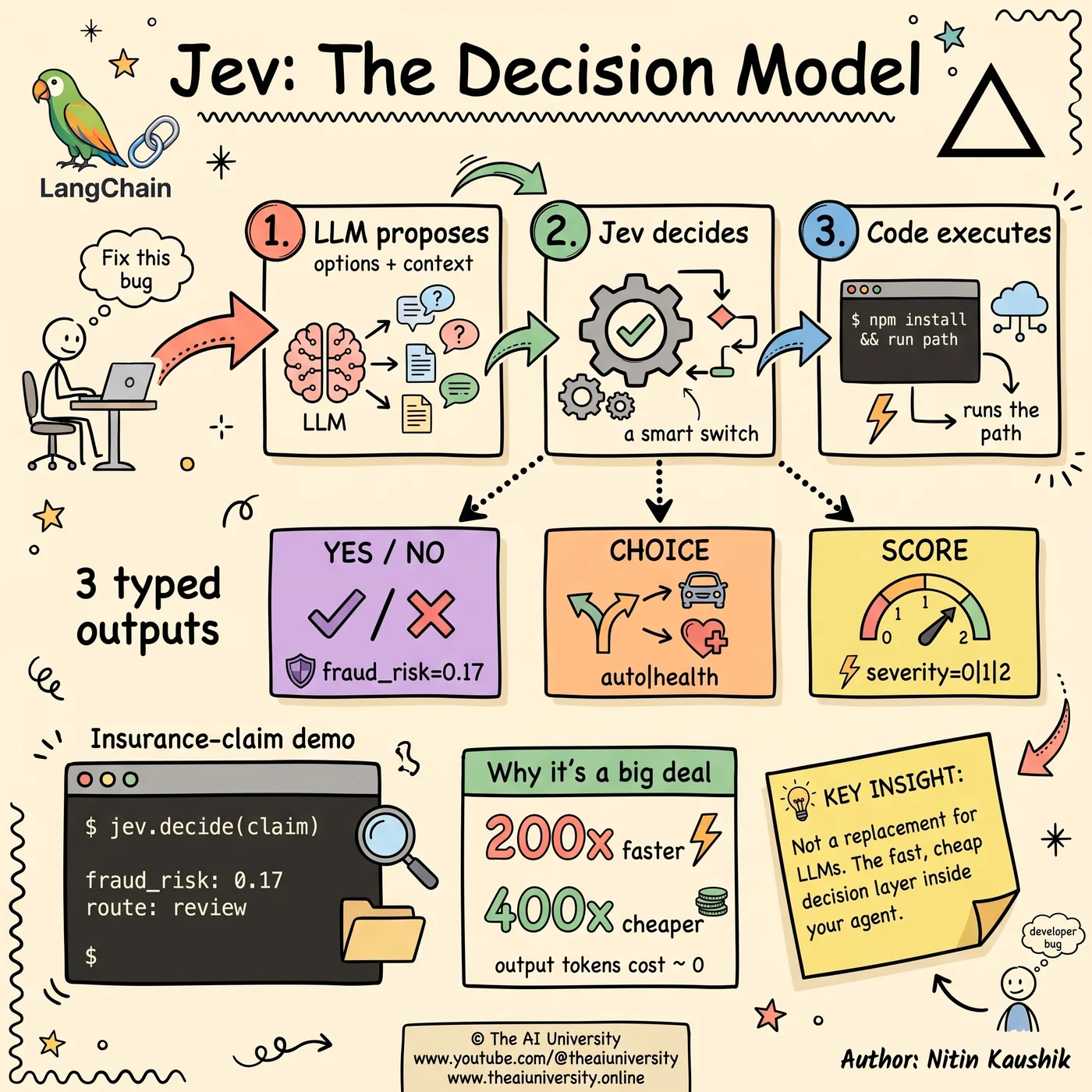
The three typed outputs Jev returns
Jev answers in three primitive types, and each one maps to a shape software already uses:
Yes/no returns a probability between 0 and 1. In an insurance-claim demo, a fraud-risk question came back as
0.17— a low, confident signal rather than a guess dressed up as prose.Choice works like a dropdown or an enum. Asked to classify a claim, it picks one of a fixed set: auto, property or health.
Score returns a category bucket. Claim severity comes back as
0,1or2— minor under $1,000, moderate between $1,000 and $10,000, or major above $10,000.
Under the hood this is close to the softmax layer that classic neural-network classifiers used to end with, assigning probabilities across a fixed set of outputs. The difference, and the whole point, is that Jev is general and understands semantics — it reads the meaning of the input rather than matching features.
Why a classifier is such a big deal
A model that only classifies sounds narrow until you look at an agentic workflow, because most of that workflow is decision-making. When a coding agent builds a project, it is constantly thinking, checking output and taking another turn — and each turn is packed with small decisions about what to do next. Those decisions are usually LLM calls, and LLM calls are the slow, costly part of the loop.
Hand the decisions to the Jev decision model and the whole workflow gets faster and cheaper. In the insurance demo the speed-up was only about 2x, because it ran in a notebook against a small, already-fast GPT-OSS model on Groq. Against the high-reasoning models people actually run in production, such as Opus, TypeSafe AI reported the gap widening to 70–80x, and the founder's own claim reaches 200x. The cost story is even starker: because a decision is just a probability distribution, output tokens are essentially free, and the founder said they did not charge for output because the amount was insignificant.
Where the Jev decision model fits in real projects
Beyond claim triage, three uses stand out for AI agent routing and control:
Dynamic model routing. LangChain ships a model router built on Jev. You specify the criteria — simple questions like order-status lookups go to a fast model, while billing disputes and refund exceptions go to a powerful one — and Jev picks the model per request instead of a semantic router or an extra LLM call.
Guardrails. Because a guardrail is just a decision, Jev can wrap dangerous tools in middleware that decides whether a suspicious request should be blocked. This use is still experimental — in testing it approved things it should not have a few times, so it needs careful evaluation before it guards anything critical.
Function calling and screening. For dropdown-style function calls, and for high-volume jobs like résumé screening where you supply the résumé and your criteria and want a decision back, Jev is far faster than having an LLM generate the whole JSON.
How Jev is trained, and its honest limits
Jev is still a language model, but it is trained and built differently from the LLMs it complements. Instead of the usual RLHF or RLVR pipeline, TypeSafe AI used a new paradigm it calls reinforcement learning for calibrated decisions (RLCD). The architecture is roughly 60–70% the same transformer base, with 20–30% customised — most importantly, it does not generate tokens autoregressively. It produces a parallel batch of probability distributions in one pass, which is where the speed comes from.
The honest caveat is that Jev is still a probabilistic AI model, so it still makes mistakes. Its hallucination rate is lower than an LLM's in the narrow sense that it picks from options rather than inventing new content — but "lower" is not "zero," as the guardrail failures showed. The same caution engineers apply to LLMs applies here: test it, and evaluate the whole pipeline before you put a decision layer into production.
Access is open. You sign up at the TypeSafe console, and there is a playground with a résumé-screening demo. There is a single model, listed as "jev-latest" — no tiers to choose between.
The bigger shift
The instinct when an AI agent is slow or expensive is to reach for a smarter, bigger model. Jev points the other way. If most of an agent's cost and latency lives in decisions rather than generation, the fix is not a better writer — it is taking the writer out of the decisions entirely. Jev is not built to replace LLMs; it is built to sit beside them, doing the deciding while the LLM does the reasoning and the code does the work. Whether calibrated decision models become a standard layer in the stack is still an open question, but the idea that "decide" and "generate" are different jobs deserving different models is a genuinely new way to think about building agents.
Frequently asked questions
What is a System One model?
A System One model is an AI model built to make fast, structured decisions rather than to generate text. The name borrows from the idea of quick, intuitive thinking: a System One model like the Jev decision model evaluates an input and returns a typed answer — a yes/no probability, a choice from a fixed set, or a score — in one pass. It does not reason step by step or produce free-form language, which is exactly why it can respond so quickly.
Do I need to know machine learning to use Jev?
No, you don't need a machine-learning background to use the Jev decision model. You sign up at the TypeSafe console, supply the input you want a decision on and the criteria for that decision, and Jev returns a typed result. LangChain and Vercel provide official integrations that handle the wiring, so most of the work is describing your decision clearly — the same skill that goes into writing a good prompt.
Is Jev a replacement for LLMs?
No, Jev is not a replacement for LLMs — it is designed to complement them. LLMs generate text, write code and reason through open-ended problems; the Jev decision model only classifies, routes and scores. The intended pattern is that the LLM proposes options, Jev decides between them, and your code executes the result. You use them together to make agentic workflows faster and cheaper, not one instead of the other.
How much faster and cheaper is Jev than an LLM?
TypeSafe AI reports the Jev decision model is up to 200 times faster and 400 times cheaper than frontier LLMs on decision tasks. Real numbers vary with the comparison: against a small, already-fast model in a notebook the speed-up was about 2x, while against a high-reasoning model like Opus it reached 70–80x. Output tokens are effectively free, because the model returns a probability distribution rather than generated text.
What can I actually build with Jev today?
You can build model routers, guardrails and classifiers with the Jev decision model today. Concrete examples from the launch include routing simple support questions to a cheap model and hard ones to a powerful one, triaging insurance claims by fraud risk and severity, and screening résumés against set criteria. The cookbooks also cover reranking, structured recovery and dropdown-style function calling. Guardrails work but are still experimental, so evaluate carefully before trusting them.
Build it yourself
Everything written about here gets built in the open — the whole application, on camera, including the parts that did not work first time.
Keep reading
 AI agent skills
AI Agent Skills: 9 Free Ones and the Step Most Skip
AI agent skills install from one pasted link — that part is easy. The step that makes them genuinely useful is the one almost nobody runs.
Read article→ open source SaaS alternatives
Open Source SaaS Alternatives: 5 Repos Worth Selling
Semrush charges $250. This costs ten.
Read article→ Claude AI side hustles
Claude AI Side Hustles: 5 That Fit Around a Full-Time Job
Claude AI side hustles work because your job already gave you the niche. Five that fit around full-time work, and the one thing that decides all five.
Read article→