
Claude AI Side Hustles: 5 That Fit Around a Full-Time Job
Claude AI side hustles work because your job already gave you the niche. Five that fit around full-time work, and the one thing that decides all five.

A Claude AI side hustle is a service business where you supply the niche knowledge and Claude does the drafting, so the work fits into nights and weekends instead of replacing your job. That distinction matters more than it sounds. The common assumption is that a second income requires quitting first — building the thing, then leaving. The five ideas below invert it: the job stays, and the expertise the job already gave you becomes the product.
Why the average side hustle stalls at $1,242 a month
The average side hustle nets about $1,242 a month, and one in four Americans already run one. Roughly 61% of the people who have a second income depend on it to get by. Those three numbers describe a real problem rather than a motivational one: a lot of people are already doing the extra work, and most of them are not being paid much for it.
The reason is usually not effort. It is that most side hustles sell time in a market with no shortage of time for sale — driving, delivery, generic freelance tasks. There is no scarce input, so the price sits where the market puts it. Every idea in this article attacks that from the same angle: pair something scarce that you already own, which is specific knowledge of a field, with something that removes the hours, which is Claude drafting the deliverable.
Five Claude AI side hustles that fit around a full-time job
All five Claude AI side hustles follow one structure — you bring the judgement, Claude collapses the production time, and something external supplies the demand. The table below is the whole system on one screen:
Side hustle | What you supply | What Claude does | Where the work comes from |
|---|---|---|---|
Wedding speeches | The couple's story, tone and inside jokes | Writes a warm, natural-sounding draft | Weekend bookings |
Resume rewriting | Judgement on what a hiring manager wants | Rewrites against the job ad, formats for the ATS | Fiverr |
Affiliate content | The niche and the recommendation | Drafts scripts, copy and comparisons | YouTube |
Pitch decks | Founder interviews and narrative structure | Turns raw notes into a ten-slide story | Founders directly |
Career coaching | 2,000+ hours in your own field | Least of the five — your experience is the product | Your own channel |
Read that last column carefully, because it is the one most people skip. The first three columns are about capability, and capability is now cheap. The fourth column is about distribution, and distribution is the part that actually decides whether any of this earns.
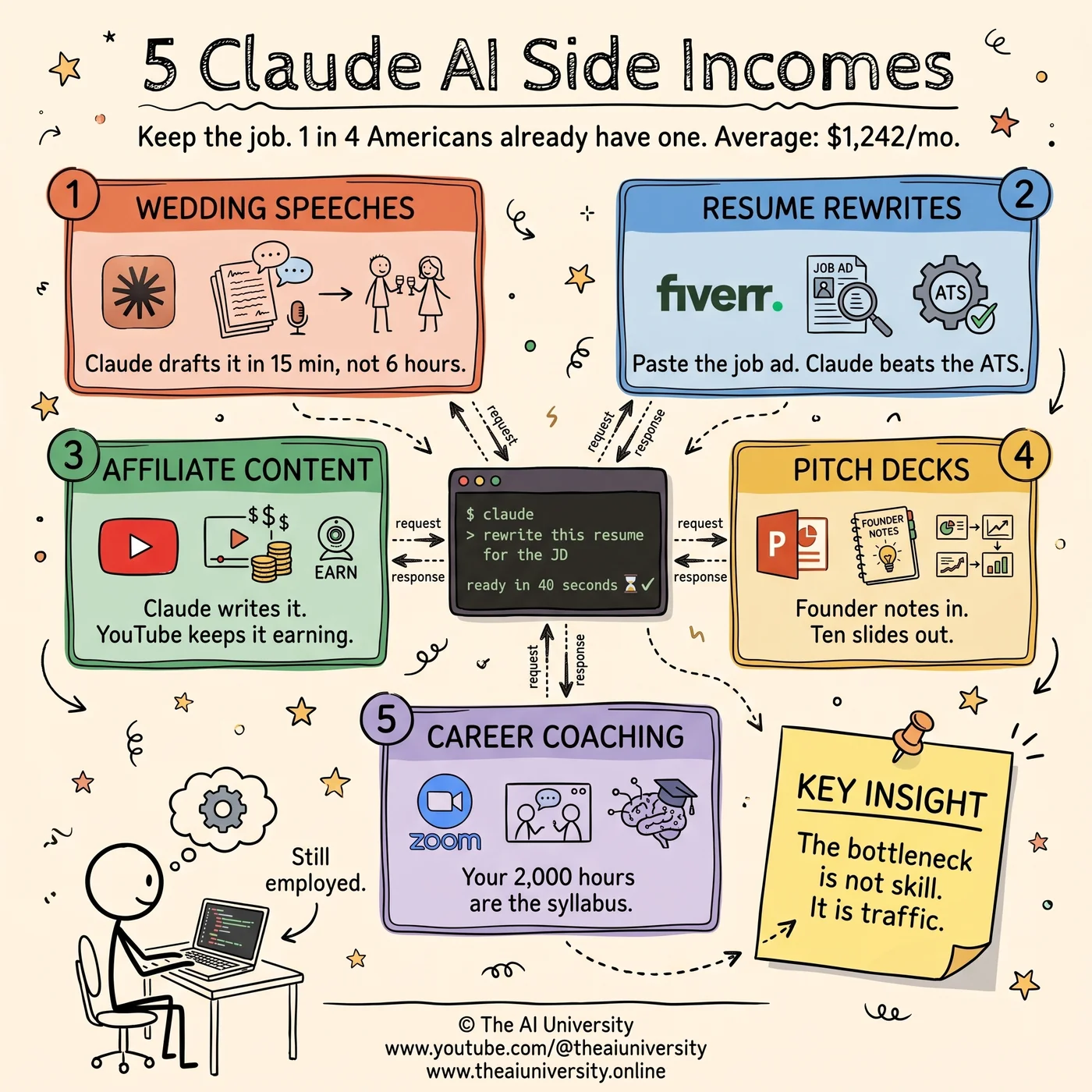
Wedding speech writing: what Claude does to a six-hour draft
Wedding speech writing is the clearest example of AI compressing a task rather than replacing a skill. A best-man or maid-of-honour speech traditionally takes five to six hours to write, mostly because the writer is staring at a blank page trying to make personal details sound warm rather than awkward. With a Claude-powered speech generator, that same job runs in about fifteen minutes.
What you actually feed Claude
The input is the raw material only a human can gather: how the couple met, the tone the client wants, the inside jokes, the names, the moments worth landing on. Claude turns that into a speech that reads as warm, funny and natural rather than templated. The client is not paying for prose — they are paying to be relieved of the blank page.
Why it is weekend-shaped work
Weddings happen on weekends, and speeches are commissioned weeks ahead. That makes this one of the few service businesses whose delivery schedule genuinely does not collide with a Monday-to-Friday job. One operator running a bridesmaid-for-hire service built this into a recurring monthly income by automating the writing step alone.
Resume rewriting: writing against the job ad and the ATS
AI resume rewriting sells well because it solves two problems at once, and only one of them is writing. A resume has to persuade a human, and before that it has to survive an applicant tracking system that filters on keywords and formatting. Claude handles both passes in a single turnaround.
Writing against the job ad
The method is specific: paste the job listing in alongside the candidate's resume, and Claude rewrites the resume against that listing rather than producing a generic polish. This is what turns a commodity gig into a service — the output is visibly tailored to one role, which is the thing a candidate cannot easily do for themselves at two in the morning.
Getting past the ATS
An applicant tracking system reads the file before any recruiter does, and it screens on structure and terminology. Claude optimises the rewrite for that layer as part of the same job. The practical effect is that delivery gets fast enough to charge full price on a weeknight and still hand over quality work.
Fiverr is where this demand already sits. A former English teacher built a substantial business selling resume rewrites on that marketplace, using AI before it was mainstream — which is the useful part of the example, because it shows the bottleneck was never the writing tool.
Affiliate content: why traffic, not the offer, is the product
Affiliate marketing is the one idea on this list where Claude is the least important variable. Claude will draft the scripts, the copy, the comparison posts and the descriptions — that part is genuinely solved. What decides whether an affiliate business earns anything is whether anyone sees it.
That is why YouTube keeps coming up. A video published once keeps earning commissions while you are in meetings, which is the only property that makes affiliate income compatible with a full-time job. Recommending career training and trade courses works as a niche precisely because the audience searching for it is already in a buying frame of mind.
The honest version of this one: affiliate marketing works if you can build an audience, and it does approximately nothing if you cannot. Anyone selling it as a passive income button is skipping the entire hard part.
Pitch decks: founder notes in, a ten-slide story out
AI pitch deck creation turns unstructured founder input into a clean, story-driven ten-slide deck. Founders almost always have the substance and almost never have the narrative order — they know the product, the market and the numbers, but not which of those goes on slide three. Claude is good at exactly that reordering.
Decks in this format sell for hundreds to around a thousand each, which makes it one of the higher-ticket options here on a per-unit basis. A pastor in Arkansas runs this as a side business, which is the point worth holding onto: the work does not require a Silicon Valley address, a design degree, or a network. It requires the ability to interview a founder and the discipline to hand back something clean.
PowerPoint is still the delivery format most clients expect, so the finished artefact is ordinary. The value is in the sequencing, not the software.
Career coaching: why 2,000 hours at work is already a syllabus
Online career coaching is the only idea on this list where your full-time job is not a constraint but the entire credential. You have already spent 2,000 or more hours mastering a field. Teaching someone how to break into that field, or move up inside it, requires no additional training — it requires organising what you already know.
This is also the one where Claude does the least, and that is worth saying plainly. The tool can structure material and speed up preparation, but the product being sold is your experience. That is what makes it durable: it is the hardest of the five to commoditise.
The range of fields that works is wider than most people assume. Accountants coach accountants. Tradespeople coach apprentices. One coach built a substantial part-time income advising on careers while still holding a senior fintech role, and another left a big-tech job to coach cybersecurity careers through a YouTube channel. Even hobbyist niches — chess among them — sustain coaching businesses.
What all five Claude AI side hustles have in common
Every one of these five Claude AI side hustles separates into the same two layers: a production layer that AI has made cheap, and a distribution layer that it has not touched. Claude collapses the six-hour speech, the resume rewrite, the deck assembly and the content drafting. None of that is where the money is decided.
The bottleneck is traffic. It is the reason the affiliate section reduces to "build an audience", the reason Fiverr matters more than the resume prompt, and the reason career coaching scales through a channel rather than through referrals alone. Build the audience and the delivery speed becomes leverage; skip it and the delivery speed just means you produce unpurchased work faster.
The other shared property is that none of them require quitting. Under four hours a week, on nights and weekends, is a realistic envelope for any of the five — which means the job that funds your life is also the job that supplies the niche knowledge you are selling. Treating it as the obstacle is the mistake. It is the input.
Frequently asked questions
What is a Claude AI side hustle?
A Claude AI side hustle is a small service business where you provide specialist knowledge and Claude handles the drafting or production, so the whole thing runs alongside a full-time job. The five covered here are wedding speech writing, resume rewriting, affiliate content, pitch deck creation and online career coaching. What they share is that the scarce input is your own expertise, not the tool.
Do I need to write code to do any of this?
No, none of the five require writing code. Every one of them runs on ordinary written instructions to Claude — you describe the couple, paste in the job ad, or hand over a founder's notes, and Claude produces the draft. What the work does require is niche knowledge and the judgement to tell a good output from a weak one, which is the part that cannot be automated.
How is this different from ordinary freelance writing?
The difference is delivery speed against a fixed price. Ordinary freelance writing charges for hours, so a six-hour wedding speech is a six-hour job. With Claude drafting, the same speech takes roughly fifteen minutes of editing while the price stays where the market sets it. The economics change because the scarce input moves from your time to your judgement about a specific field.
How many hours a week do these actually take?
Under four hours a week is a realistic envelope for any of the five, run on nights and weekends. Wedding speeches are commissioned weeks ahead and delivered at weekends. Resume rewrites turn around fast enough to complete on a weeknight. Affiliate content and coaching build over time rather than demanding a fixed weekly block. None of the five require weekday availability, which is what makes them compatible with a job.
Why does Fiverr keep coming up for resume work?
Fiverr matters because it supplies the demand, which is the hardest part of any of these businesses. Resume rewriting on Fiverr puts you in front of people already searching to buy that exact service, so you skip the audience-building step entirely. A former English teacher built a substantial resume-rewriting business on that marketplace, using AI before it was mainstream — evidence that the marketplace, not the tool, was doing the heavy lifting.
Do you need an audience before you start?
It depends on which of the five you pick, and this is the real fork in the road. Affiliate content and online career coaching both scale through an audience, usually a YouTube channel, and they earn very little without one. Resume rewriting borrows an existing audience from a marketplace like Fiverr. Wedding speeches and pitch decks are sold client by client, so they start earning fastest and scale slowest.
Build it yourself
Everything written about here gets built in the open. The community on Skool is where the source, the prompts and the questions live.
Join the community →Keep reading
 agentic AI system design
Agentic AI System Design: 9 Layers That Break in Production
Agentic AI system design is backend engineering, not prompting. The nine layers that decide whether your agent survives production.
Read article→ Model Context Protocol
Model Context Protocol: What It Is and Why It Matters
Model Context Protocol exists because your AI agent still cannot call an API. Here is the exact division of labor between the model, the client, and the server.
Read article→ agent harnessing
Agent Harnessing: Why AI Agents Fail on Long Tasks
Agent harnessing is why long AI tasks finally finish. The fix isn't a bigger context window — it's a loop that never needs to remember.
Read article→