
Local AI Tools: 6 Free Self-Hosted Alternatives to Cloud AI Subscriptions
Local AI tools are quietly beating the cloud subscriptions they replace. Seven self-hosted picks for video, code memory, forecasting and voice.

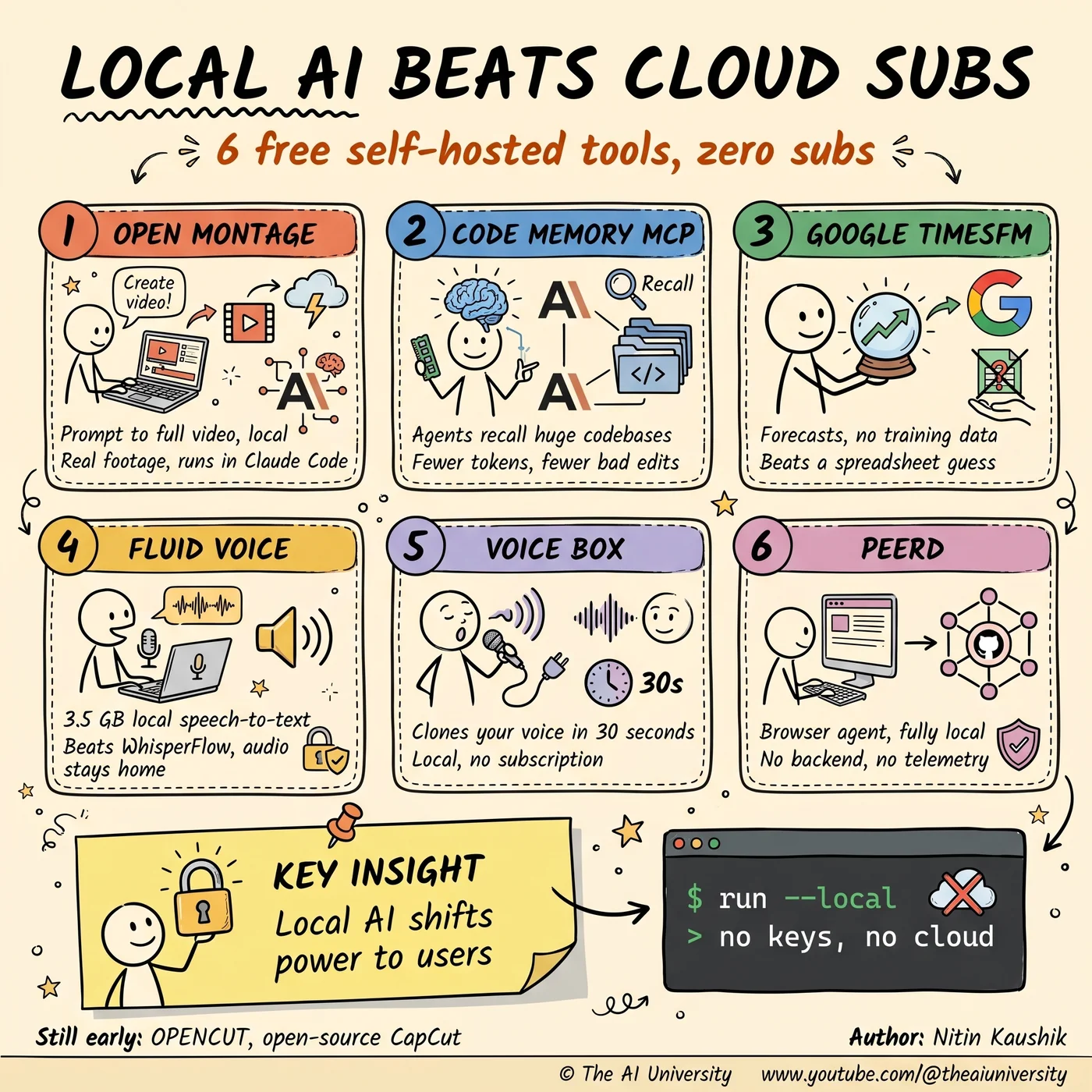
Most people are still paying a monthly subscription for AI tools their own laptop can now run for free. Over the past week a wave of local AI tools has closed the gap with their cloud counterparts, matching or beating them on speed, privacy and output quality without a recurring bill. Testing seven of them side by side — spanning video editing, coding-agent memory, forecasting, speech-to-text, voice cloning and browser agents — made one thing clear: self-hosting is no longer the compromise option. In several categories it is now simply the better one.
This is not a theoretical trend. Every tool below was actually run, and in more than one case it directly replaced a paid cloud service that had been in daily use.
Open Montage: a local AI video editor without the "AI slop" look
Most AI video editors are all style and no substance. Open Montage takes the opposite approach, and it is the clearest example of how far local AI tools have come.
Two sentences in, a finished video out
You feed it a two-sentence prompt. It scripts, edits and renders a seamless video from there. The output looks professional and dramatic — like something cut by a real editor rather than assembled by a template.
Real stock footage, not generated filler
The footage is real stock, not AI-generated filler. That single decision is what separates it from the "AI slop" aesthetic that makes most generated video instantly recognisable, and it is why the finished cut holds up next to human-edited work.
It plugs into Claude Code
Open Montage runs locally with no API keys required. It also plugs into Claude Code, which means it is modular rather than monolithic — you mix and match tools on your own terms instead of accepting one editor's fixed idea of a workflow. Tools like Descript and CapCut are getting close on capability, but they still feel clunky or limited by comparison, precisely because they are one-size-fits-all products rather than components.
Repo: github.com/calesthio/OpenMontage
Code Based Memory MCP: making coding agents remember without burning tokens
Anyone running an AI coding agent across several projects has hit the same wall — the agent forgets, re-reads the same files, and eventually makes a confident change that is wrong because it never understood how the pieces fit together. Code Based Memory MCP exists to solve exactly that.
Massive codebases, remembered seamlessly
It helps coding agents get smarter and cheaper by remembering massive codebases seamlessly, rather than reconstructing context from scratch on every request.
Fewer tokens, fewer bad edits
The payoff is twofold: you stop burning through tokens re-establishing context, and you stop getting dumb changes that come from an agent operating blind. If you juggle multiple projects and want your AI to understand complex interdependencies, this is the piece that has been missing.
Google TimesFM: forecasting time series with no training data
Google's TimesFM model surprised a lot of people by predicting time series — things like ad performance or inflation — without any task-specific training data.
How it works
It decomposes a series into its underlying trend and seasonality, and the resulting forecasts are better than a simple spreadsheet projection.
Why it matters beyond accuracy
Numerical forecasting has historically required a data science team to set up and validate before anyone would trust the output. TimesFM unlocks numerical AI for everyday business use without that overhead — you no longer need to hire, or become, a data scientist to get a usable forecast.
Repo: github.com/google-research/timesfm
Fluid Voice: local speech-to-text that beat the cloud tool it replaced
Fluid Voice is a 3.5 GB local, open-source speech-to-text tool, and it is the clearest head-to-head win in this list.
Faster and better with slang than WhisperFlow
In testing it beat WhisperFlow on both speed and slang recognition. Those are the two metrics that actually matter for transcription, and losing on both is a hard result for a paid cloud tool to argue with.
Your audio never leaves the machine
Because it runs locally, it keeps your audio private — nothing is uploaded for processing and nothing sits in a provider's logs afterwards. That matters most for anyone transcribing unreleased or sensitive material.
Fluid Voice is also the sharpest illustration of a wider pattern: a growing movement switching from cloud subscriptions to self-hosted models for speed, control and data privacy.
Voice Box: local voice cloning in under 30 seconds
Voice cloning got real this year too, and Voice Box is the reason.
Under 30 seconds, no subscription
It clones your voice locally in under 30 seconds with stunning realism, and there is no subscription attached.
Fix a take without re-recording
The practical use is obvious once you have needed it: fixing a podcast or a video without re-recording the segment. For anyone publishing audio or video regularly, that removes one of the most tedious jobs in post-production — and it does it without sending a sample of your own voice to someone else's server.
Peerd: a local browser agent with no backend and no telemetry
Peerd is a local-browser AI agent with no backend and no telemetry, which makes it close to ideal for privacy-sensitive work. An agent with nothing to phone home to removes a whole category of concern by architecture rather than by a settings toggle that a future update could quietly reverse.
Repo: github.com/NotASithLord/peerd
The bigger shift: local AI hands control back to users
Here is the part most people miss. Local AI and modular agents are shifting power back to users. No more waiting for centralized AI services that arrive with restrictions attached, or the standing risk of a data leak on someone else's infrastructure. None of these open source AI tools ask for a subscription, and none of them require handing over your video, your codebase, your recordings or your voice before you are allowed to work.
If you want AI tools that respect your data, boost your creativity, and let you build your exact workflow rather than a vendor's, this is where you start. It will not be the right call for every tool yet — OpenCut is proof of that — but for video editing, coding memory, forecasting, transcription and voice cloning, the local option is now genuinely competitive.
Frequently asked questions
What is Open Montage and how is it different from AI video editors like CapCut?
Open Montage is a local, open-source AI video editor that turns a two-sentence prompt into a finished, edited video using real stock footage rather than AI-generated filler, which is what keeps its output from having the “AI slop” look common to generated video. It runs locally with no API keys required and plugs directly into Claude Code, so it works as a modular component rather than a fixed, one-size-fits-all product like Descript or CapCut.
How does Code Based Memory MCP help AI coding agents?
It lets coding agents remember massive codebases seamlessly across sessions instead of reconstructing context from scratch on every request. That stops two problems at once: burning through tokens re-establishing context, and the agent making confident but wrong edits because it never understood how the pieces of the codebase fit together.
Do I need a data science background to use Google's TimesFM for forecasting?
No. TimesFM predicts time series — things like ad performance or inflation — without any task-specific training data, by decomposing a series into its underlying trend and seasonality. That removes the data science team historically needed to set up and validate a forecasting model, making usable forecasts available for everyday business use.
Is Fluid Voice actually better than paid transcription tools?
In direct testing, Fluid Voice — a 3.5 GB local, open-source speech-to-text tool — beat WhisperFlow on both speed and slang recognition, the two metrics that matter most for transcription. Because it runs locally, audio is never uploaded, so nothing sits in a provider's logs afterward either.
How fast is Voice Box's voice cloning, and is it private?
Voice Box clones a voice locally in under 30 seconds with no subscription required. Because the cloning happens on-device, it's useful for fixing a podcast or video take without re-recording, and without sending a voice sample to someone else's server.
Build it yourself
Everything written about here gets built in the open — the whole application, on camera, including the parts that did not work first time.
Keep reading
 AI agent skills
AI Agent Skills: 9 Free Ones and the Step Most Skip
AI agent skills install from one pasted link — that part is easy. The step that makes them genuinely useful is the one almost nobody runs.
Read article→ Jev decision model
Jev Decision Model: The AI That Can't Write, Only Decides
The Jev decision model can't write a word. Vercel and LangChain added it anyway. Why a "System One" classifier is 200x faster than the LLM in your agent.
Read article→ open source SaaS alternatives
Open Source SaaS Alternatives: 5 Repos Worth Selling
Semrush charges $250. This costs ten.
Read article→