
Forward Deployed Engineer: What It Is and What It Pays
The Forward Deployed Engineer exists because 95% of AI pilots fail. What the role does, what it pays, and the portfolio that gets you hired.
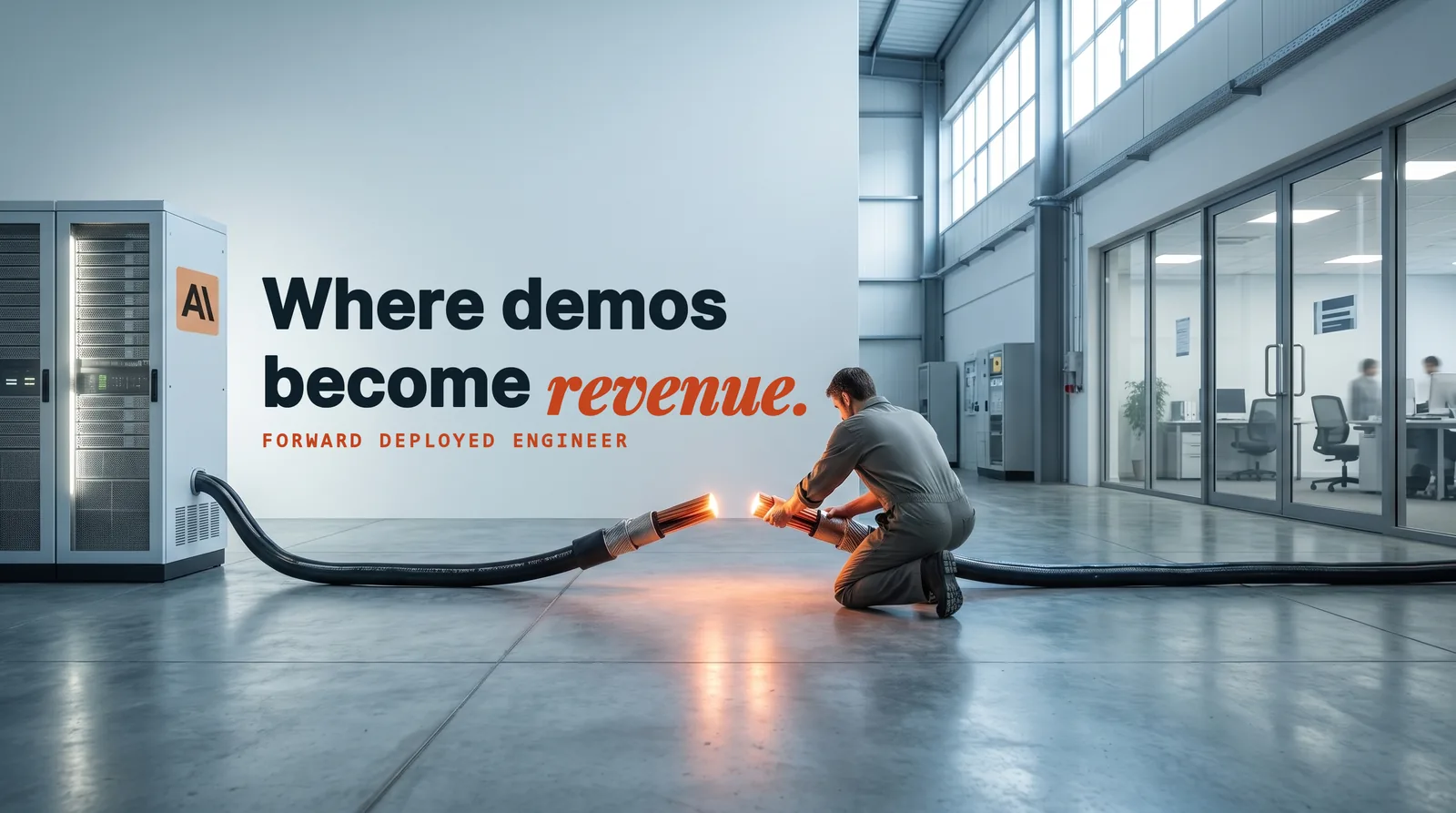
A forward deployed engineer is a software engineer who works inside the customer's environment rather than back at headquarters — scoping the real problem on site, building against the customer's actual data, deploying into their actual infrastructure, and proving the result with numbers the business already tracks. The role exists because of a gap that has become impossible to ignore: the models work, and almost nothing changes. MIT's Project NANDA reviewed more than 300 public enterprise AI initiatives for its 2025 report The GenAI Divide: State of AI in Business, alongside interviews across 52 organisations and 153 senior leaders, and found that roughly 95% of GenAI pilots reported no measurable P&L impact. Not 95% of models failed. 95% of deployments never reached the number.
That gap has a job title, and most people have never heard it.
Why 95% of enterprise AI projects never touch the P&L
Enterprise AI projects fail at deployment, not at the model layer. The pilot demonstrates something impressive in a controlled setting, the demo lands, the budget gets approved — and then the work of connecting it to real data, real permissions, real edge cases and a real workflow turns out to be a different discipline entirely, one nobody staffed for. The MIT Project NANDA finding is not a verdict on model quality. It is a verdict on the distance between a working model and a working business process.
The distance is mostly unglamorous. Data lives in three systems that disagree with each other. The API that the demo mocked has rate limits and a two-week access request. The workflow the agent was supposed to automate has four exceptions nobody documented because everyone in the department already knows them. None of that is solved by a better prompt or a larger context window, and none of it can be solved from a distance.
What a forward deployed engineer actually does
A forward deployed engineer ships working code into the customer's mess. That is the whole distinction, and it is worth being precise about, because three adjacent roles already exist and none of them do this.
How the FDE differs from a sales engineer, architect or software engineer
Sales engineers sell the system — they demonstrate what it could do
Solution architects draw the system — they produce the blueprint for what should be built
Software engineers build the system — they write the product back at headquarters
Forward deployed engineers show up on site and make it work in the customer's environment, with the customer's data, against the customer's constraints
The first three roles all hand something off. The forward deployed engineer is the one holding the outcome when the handoffs run out. That is why the role reads as uncomfortable to a lot of engineers: there is no clean interface between "my part" and "their part," because the whole job lives in the seam.
Where the forward deployed engineer role came from
Palantir invented the forward deployed engineer role around 2005, placing engineers directly alongside CIA, NSA and Army customers to build custom workflows on site rather than shipping a general-purpose product and hoping. It is a two-decade-old model, not a 2025 invention — which matters, because it means the pattern has been tested somewhere other than an AI hype cycle.
Palantir's five-year total return is roughly 610%. That is correlation rather than causation — a hiring model does not move a share price on its own — but the forward deployment model is how the company delivers, and the delivery is what customers renew. The more direct evidence that the pattern works is who is copying it: OpenAI, Anthropic, Google and Salesforce are all now hiring against the same shape.
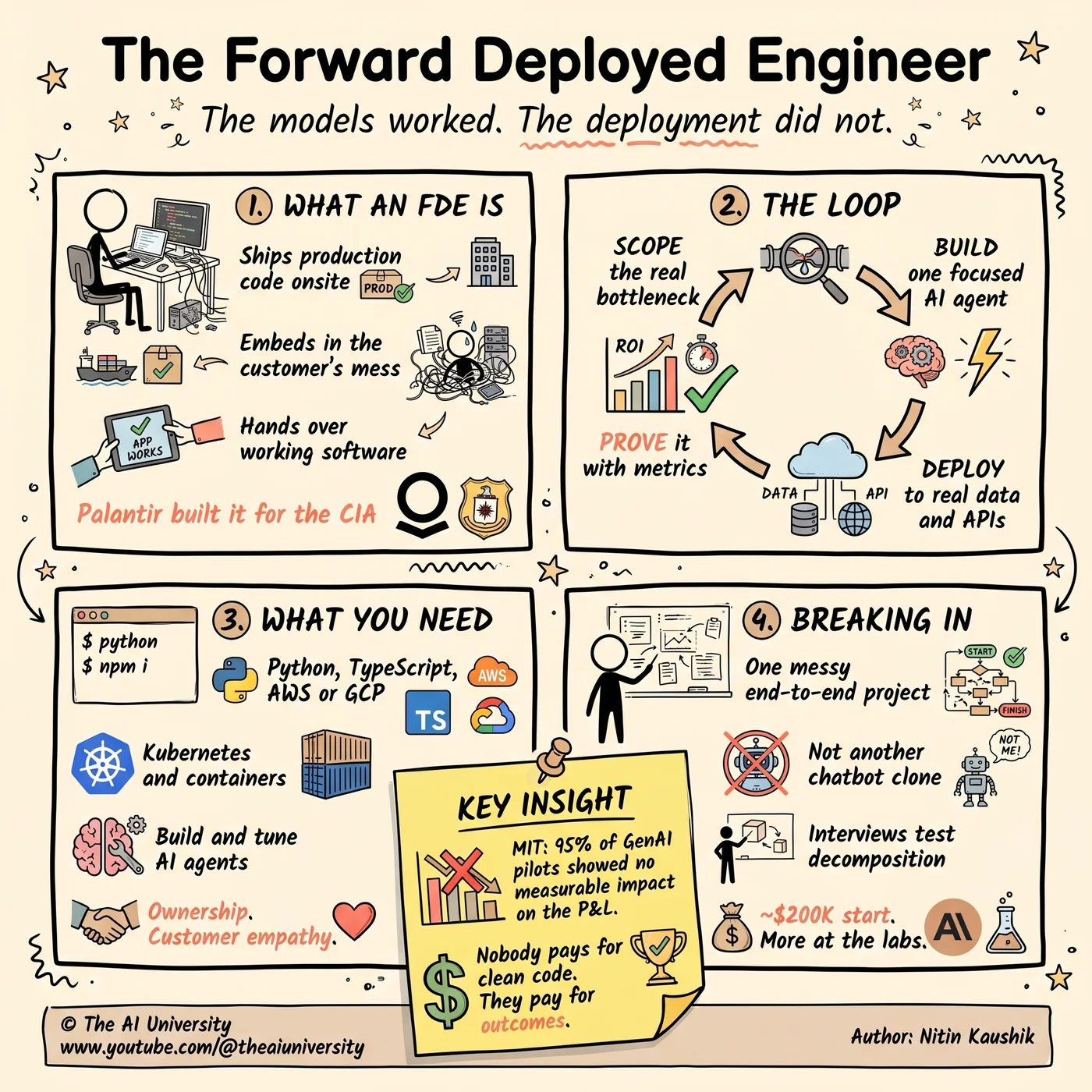
The daily loop: scope, build, deploy, prove
Forward deployed engineering runs on a four-stage loop, repeated per problem:
Scope — find the one real bottleneck worth solving inside a vague business problem. The customer rarely arrives with a well-formed brief; they arrive with a complaint. Converting the complaint into a solvable, measurable unit of work is the first deliverable.
Build — develop one focused AI agent that tackles that bottleneck. One. The temptation to build the platform instead of the fix is the most common way this stage goes wrong.
Deploy — integrate with real data and real APIs, and debug in the production environment rather than in a notebook. This is where most of the surprises live.
Prove — validate the impact with metrics and monitoring the business already trusts.
The fourth stage is the one that separates this role from ordinary contracting. Proving impact is not a report written at the end; it is instrumentation built in from the start, because a result nobody can measure is indistinguishable from a result that did not happen.
What a forward deployed engineer salary looks like
Forward deployed engineer compensation runs high because the role is scarce and the outcome is attributable. The figures below come from industry compensation reports rather than company disclosures, so treat them as bands rather than quotes:
Level | Total compensation |
|---|---|
Entry | around $200K |
Palantir average | around $238K |
Frontier labs, mid-to-senior | $350K–$550K |
Top of band (staff level, Anthropic) | past $1M |
One detail changes how those numbers should be read: equity is typically 55–70% of the total. Base salary alone materially understates the package at the top of the range and materially overstates its certainty — a $500K number that is 60% equity is a different financial object from a $500K salary, and it is worth understanding which one is being offered before comparing two of them.
The skills that get you into forward deployed engineering
The skill profile is unusual because it is genuinely two profiles at once, and candidates tend to arrive strong in one and thin in the other.
Technical depth, not tutorial familiarity
Python, TypeScript, a cloud platform (AWS or GCP), and container orchestration with Kubernetes — at real depth, because you will be debugging someone else's infrastructure under time pressure with no local reproduction. On top of that, genuine fluency building and tuning AI agents, which is a different skill from calling an API. Knowing how to make a model do something is table stakes; knowing why it stopped doing it reliably in week three is the job.
Judgement, which is the half that gets underestimated
Radical ownership, problem decomposition, product sense, customer empathy, and a high tolerance for ambiguity. These read like soft-skill filler on a job description and they are the actual differentiator here. Every technical decision in a customer environment is made with incomplete information and a stakeholder watching, and the engineer who can say "here is what I would cut and why" is worth more than the engineer with the cleaner implementation.
The portfolio that gets you the interview
Stop shipping chatbot clones. A portfolio of tutorial projects demonstrates that you can follow a tutorial, which is not the thing being hired for.
Build one genuinely messy project that runs the whole forward deployment loop end to end: use public or synthetic data, solve a real bottleneck rather than a toy task, connect it to real production infrastructure, and document the entire thing like a product manager would — the problem, the constraint, the decision, the trade-off, the measured result. One project documented that way outperforms six clean repositories, because it is the only artefact that shows judgement rather than syntax.
How the forward deployed engineer interview goes
Forward deployed engineer interviews test three things: behavioural ownership, technical depth across coding and system design, and problem decomposition through case studies. The case study round is the one candidates under-prepare, because it does not have a right answer to memorise.
Three habits carry that round. Think out loud — the interviewer is evaluating the reasoning, and silent reasoning is unscoreable. Clarify before solving — the case is deliberately vague, and jumping straight to a solution is itself the failure being tested for, since it is exactly what goes wrong on a real engagement. Explain the reasoning behind each decision rather than just stating it, because the job involves defending choices to a customer who is paying for them.
The bigger shift: measurable outcomes are the product
Read the role together and the pattern is blunt:
Models are solved. Deployment is not.
Clean code is not the product. Measurable outcomes are.
Nobody is paying six figures for clean code. They are paying for someone who turns a messy customer workflow into a number the business can actually see — and that is a different job from the one most engineering careers are built around, which is why the supply is thin and the compensation is not. The forward deployed engineer role is not for timid coders. It is for people comfortable owning the outcome inside someone else's chaos, which is an unusual thing to be comfortable with and an increasingly valuable one.
Frequently asked questions
What is a forward deployed engineer?
A forward deployed engineer is a software engineer who works inside the customer's environment instead of at headquarters, scoping the real bottleneck on site, building against the customer's data, deploying into their infrastructure and proving the result with metrics. Sales engineers sell the system, architects draw it and software engineers build it — the forward deployed engineer is the one who makes it work where the customer actually is.
Do you need to be a senior engineer to become one?
Not senior, but not junior either — the entry band sits around $200K, which signals real depth rather than a first job. What the role demands is Python, TypeScript, a cloud platform like AWS or GCP, and Kubernetes at genuine working depth, plus fluency building and tuning AI agents rather than just calling an API. The judgement half — ownership, decomposition, product sense, tolerance for ambiguity — matters at least as much as the years.
How is a forward deployed engineer different from a solutions architect?
A solutions architect produces the blueprint; a forward deployed engineer ships the working code. The architect's deliverable is a design that someone else implements, which means the handoff is the end of their involvement. The forward deployed engineer has no handoff — they are on site with the customer's real data and real APIs, debugging in production, and they still own the outcome when the plan meets the exceptions nobody documented.
How much does a forward deployed engineer make?
Forward deployed engineer compensation runs from around $200K at entry to $350K–$550K mid-to-senior at frontier labs, with the top of Anthropic's staff-level band past $1M. Palantir averages around $238K. These figures come from industry compensation reports rather than company disclosures, so treat them as bands. Equity is typically 55–70% of the total, which means base salary alone is a misleading comparison point.
Why do 95% of enterprise AI projects fail?
Enterprise AI projects fail at deployment rather than at the model. MIT's Project NANDA reviewed more than 300 public AI initiatives for its 2025 report The GenAI Divide, plus interviews across 52 organisations and 153 senior leaders, and found roughly 95% of GenAI pilots reported no measurable P&L impact. The models worked. Connecting them to real data, real permissions, real edge cases and a real workflow is a separate discipline that most projects never staffed.
What kind of portfolio project gets a forward deployed engineer hired?
One genuinely messy project beats six clean repositories. Build something that runs the full loop — scope a real bottleneck, use public or synthetic data, connect it to real production infrastructure, and document the problem, constraints, trade-offs and measured result the way a product manager would. Chatbot clones demonstrate that you can follow a tutorial, which is not what the role is hiring for.
Build it yourself
Everything written about here gets built in the open. The community on Skool is where the source, the prompts and the questions live.
Join the community →Keep reading
 Claude AI side hustles
Claude AI Side Hustles: 5 That Fit Around a Full-Time Job
Claude AI side hustles work because your job already gave you the niche. Five that fit around full-time work, and the one thing that decides all five.
Read article→ agentic AI system design
Agentic AI System Design: 9 Layers That Break in Production
Agentic AI system design is backend engineering, not prompting. The nine layers that decide whether your agent survives production.
Read article→ Model Context Protocol
Model Context Protocol: What It Is and Why It Matters
Model Context Protocol exists because your AI agent still cannot call an API. Here is the exact division of labor between the model, the client, and the server.
Read article→