
AI Agents: How One Person Builds a Whole Company for Under $11
AI agents don't forget when you close the laptop. Here's the five-agent setup one person used to build and run a company for eleven dollars.

Most people still use AI the way they used a search box: open a tab, ask a question, close the tab, and lose everything that just happened. AI agents work on a different principle. They keep state, they run on a schedule, and they carry out multi-step work long after you have shut the laptop. That difference sounds academic until you see what one person can assemble with it — a working offer, a company structure, a 24/7 analyst, and a set of reusable parts, all of it running in a browser with no code and a build cost under ten dollars.
This article walks through the six pieces of that setup, what each one actually does, and why the combination matters more than any single piece.
Why AI agents are not chatbots
The distinction that matters is persistence. A chatbot session is a conversation that ends. An agent is a process that continues — it remembers what it was asked to do, and it keeps doing it on its own schedule rather than waiting for your next message.
That changes what you can put an AI in charge of. A chatbot can draft an email about competitor research. An agent can go and do the competitor research every thirty minutes, indefinitely, and tell you when something changed. The first is a writing aid. The second is closer to a job function.
The second thing worth clearing up is the assumption that this is developer territory. It isn't. The entire setup described here runs in the browser and requires no coding. The barrier that used to sit between "I have an idea for an automated business" and "I have an automated business" was implementation, and that barrier is largely what agents remove.
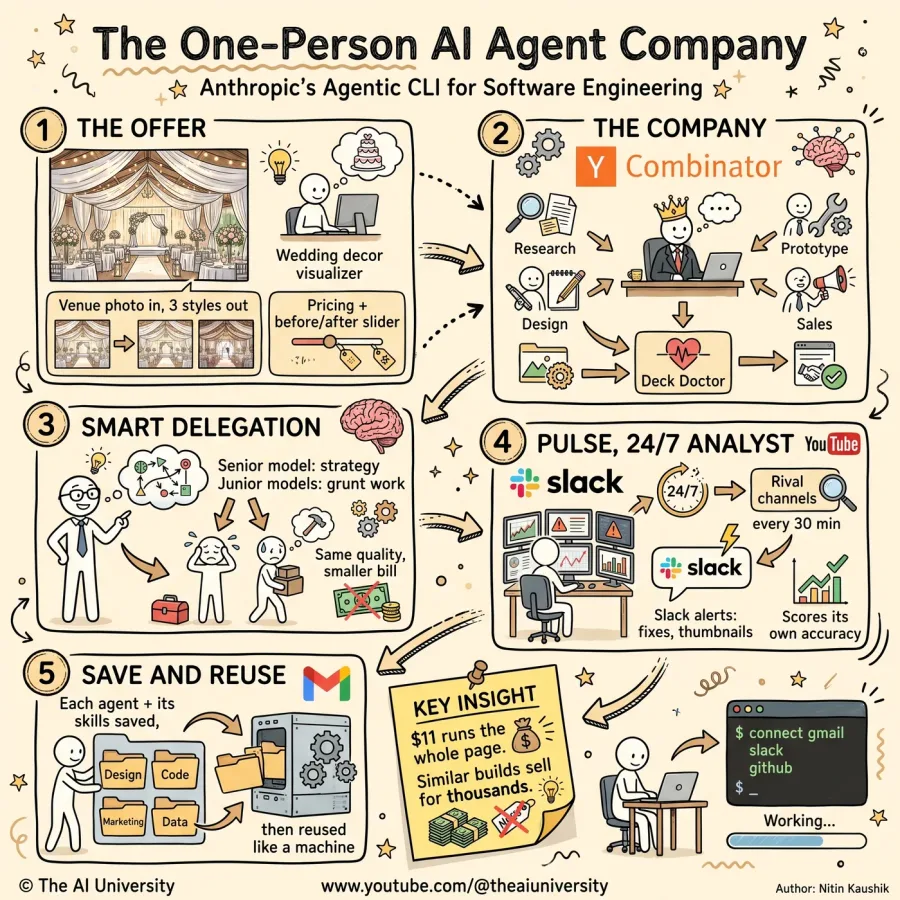
The offer: an AI that decorates the venue before you book it
The first piece is the thing you actually sell. In this build it is a wedding decor visualizer, and the mechanic is simple enough to explain in a sentence: send a photo of an empty venue, and the AI returns fully decorated versions of that same venue, with pricing, in minutes.
The reason this works as a business offer rather than a demo is that it removes imagination from the sale. A couple standing in an empty hall is being asked to picture something and then trust a quote attached to it. Showing them their own venue, dressed, at a real price, replaces a leap of faith with a decision.
It asks before it generates
The agent does not simply take the photo and guess. It collects the event details first — guest count, budget, style preference — and generates against those constraints. That ordering is what separates a novelty image generator from something that produces a quotable proposal: the output is conditioned on the facts that determine cost.
Three concepts and a slider
The output is three styled decor concepts, each with pricing attached, presented on an interactive page with a slider to compare before and after. The slider matters more than it sounds like it should. It is the element that makes the transformation legible at a glance, and it is doing the persuasive work that a salesperson would otherwise have to do in person.
What it costs to run
The entire interactive sales page — the thing a client sees, clicks through, and makes a decision on — costs eleven dollars to run. The build itself came in under ten dollars.
It is worth sitting with that number, because it is the part that reframes everything else. A single custom interactive page of this kind is the sort of deliverable that agencies charge thousands for. The gap between eleven dollars of running cost and a four-figure price tag is not a small efficiency gain; it is a different business model. It means you can build the page speculatively, for a prospect who has not paid you yet, and still be far ahead if one in fifty converts.
Building the company: one CEO agent, four specialists
The second layer is more ambitious than a single offer. Instead of one agent doing one job, the structure is a CEO agent directing four specialist agents: research, prototype builder, designer, and sales closer. You hand the CEO an idea, and the organisation underneath it goes to work.
The worked example is a service called Deck Doctor — pitch-deck consulting. From that starting point, the four specialists produce four different kinds of output.
Research
The research agent sizes the market, identifies competitors, maps existing pricing, and highlights the gaps in what is currently offered. This is the piece that would normally consume the first week of any new venture, and it is the piece most solo founders skip or do badly.
The prototype builder
The prototype agent builds a clickable prototype website — in the Deck Doctor case, one offering free teardowns as a lead-in and paid services behind them. Note that this is a functioning funnel structure, not a mockup: a free entry point that qualifies interest, and a paid tier that captures it.
The designer
The design agent handles branding and user interface, and the standard it is held to is worth naming: the result should look seasoned rather than rushed. Design is where most solo-built businesses signal their size accidentally, and it is unusually high-leverage to get right early.
The sales closer
The sales agent finds real, named startup customers to pitch, pulling live data from sources like Y Combinator. This is the step that most clearly separates an agent from a chatbot. It is not generating a description of an ideal customer profile; it is going out to a live source and returning specific companies you could contact.
Model arbitrage: using cheap models on purpose
There is a cost-control mechanic underneath all of this that is easy to overlook. The CEO agent delegates tasks between expensive and cheaper AI models deliberately — the senior model handles strategy, and junior models do the grunt work.
This mirrors how a real firm allocates people, and for the same reason. Most of the tokens in any workflow are spent on volume tasks that do not require the strongest available reasoning: reformatting, extracting, summarising, filling in structure. Routing those to a cheaper model while reserving the expensive one for the decisions that actually shape the output keeps quality where it matters and cuts the bill everywhere else. It is the difference between an agent setup that is a fun demo and one you can afford to leave running.
Pulse: the analyst that never sleeps
The third layer is monitoring, and it is the piece that most resembles hiring someone. Pulse is a 24/7 analyst agent. It watches your YouTube channel, your competitors' channels, and your performance every thirty minutes, continuously.
Alerts that carry fixes, not just numbers
When something warrants attention, Pulse alerts you via Slack — and the alert includes fixes and thumbnail ideas rather than a bare metric. This is the distinction between a dashboard and an employee. A dashboard tells you the number moved. An analyst tells you what to do about it.
It grades its own accuracy
Pulse also scores its own accuracy. That is an unusual and genuinely important property: an agent that tracks how often its own recommendations were right gives you a basis for deciding how much to trust it, instead of asking you to take every alert at equal weight. It also builds a daily dashboard that updates automatically, so the long view is maintained without anyone maintaining it.
Reusability: agents as parts on a shelf
The final piece is what makes the whole thing compound instead of resetting each time. Each agent and its skills are saved separately, which means they become components rather than one-off conversations. A research agent built for Deck Doctor is a research agent you already own the next time you have an idea.
Saved this way, the workflows become repeatable and machine-like — the same sequence, run again, on a new input. And they connect outward with one click into the tools where the work actually lives: Gmail, Slack, GitHub. An agent that can read your inbox and write to your repository is operating inside your business rather than beside it.
The bigger shift
Taken separately, each of these six pieces is interesting. Taken together, they describe something that did not previously exist at this price: a single person operating a structure that used to require a team, at a cost that used to require funding.
The throughline is that AI stops being a tool you consult and becomes infrastructure you build on. The offer sells itself, the company assembles itself, the analyst reports without being asked, and the parts are saved for the next build. Build once, sell repeatedly, and let the automated layer handle the parts that used to consume the week. That is a practical change in what one person can run, and it is available now rather than at some point in the future. The tool behind this particular build is HyperAgent.
Frequently asked questions
What is the actual difference between an AI agent and a chatbot?
Persistence. A chatbot session is a conversation that ends when the tab closes; an agent is a process that keeps running — it remembers what it was asked to do and keeps doing it on its own schedule rather than waiting for the next message. That is what lets an agent do recurring work, like competitor research every thirty minutes, instead of producing a one-off answer.
Do you need to know how to code to build something like this?
No. The entire setup described — the sales offer, the CEO/specialist agent structure, and the monitoring agent — runs in the browser and requires no coding.
What does the “CEO agent” structure actually do?
A CEO agent directs four specialist agents — research, prototype builder, designer, and sales closer — from a single idea. In the worked example, a pitch-deck consulting service called Deck Doctor, the research agent sizes the market and competitors, the prototype agent builds a working funnel with a free and paid tier, the designer handles branding and UI, and the sales agent pulls live data, from sources like Y Combinator, to find named, contactable prospects.
What is “model arbitrage” and why does it matter for cost?
It is deliberately routing tasks between expensive and cheaper AI models — the senior model handles strategy, and junior models handle volume work like reformatting, extracting and summarising. Most of the tokens in a workflow go to tasks that do not need the strongest reasoning, so this keeps quality where it matters while cutting the bill everywhere else — the build in this piece cost under ten dollars, and the resulting sales page runs for eleven.
What makes Pulse different from a normal analytics dashboard?
Pulse is a 24/7 analyst agent that checks a YouTube channel and its competitors every thirty minutes and alerts you via Slack — but the alert includes fixes and thumbnail ideas, not just a number. It also scores its own accuracy over time, so you have a basis for trusting its recommendations rather than treating every alert equally.
Build it yourself
Everything written about here gets built in the open — the whole application, on camera, including the parts that did not work first time.
Keep reading
 AI agent skills
AI Agent Skills: 9 Free Ones and the Step Most Skip
AI agent skills install from one pasted link — that part is easy. The step that makes them genuinely useful is the one almost nobody runs.
Read article→ Jev decision model
Jev Decision Model: The AI That Can't Write, Only Decides
The Jev decision model can't write a word. Vercel and LangChain added it anyway. Why a "System One" classifier is 200x faster than the LLM in your agent.
Read article→ open source SaaS alternatives
Open Source SaaS Alternatives: 5 Repos Worth Selling
Semrush charges $250. This costs ten.
Read article→