
3 Businesses You Can Start on the Agent Internet
The agent internet pays per request, not per page view. Cloudflare's HTTP 402 stack, and three businesses you can start by hand.
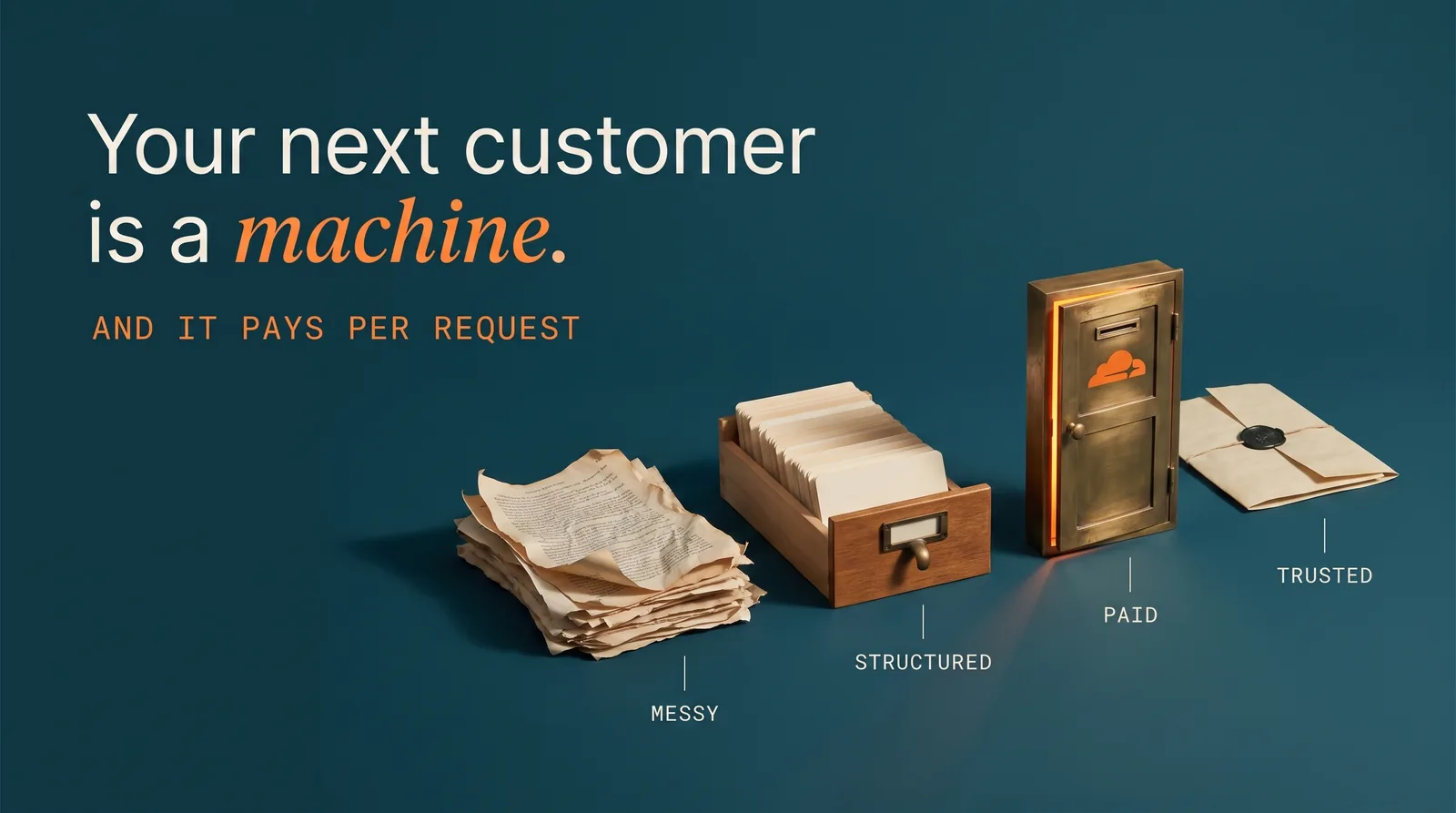
Nobody visits your site any more. The agent reads the answer and leaves, and the visit you used to monetise never happens.
For twenty years the web ran on one bargain: you gave your data to search engines, and search engines sent you humans who bought things. That trade is breaking, and it is breaking quietly — traffic falls while the information is used more than ever.
Cloudflare made it possible to charge the machines instead. Here is what changed, and three businesses you can start by hand on top of it.
The short version
- Messy data = the raw material. Structure = what makes it usable.
- Payment = what makes it a business. Trust = what makes them come back.
- You do not have to wait for the infrastructure to finish being built. Start manual, start small.
1. The old bargain is breaking
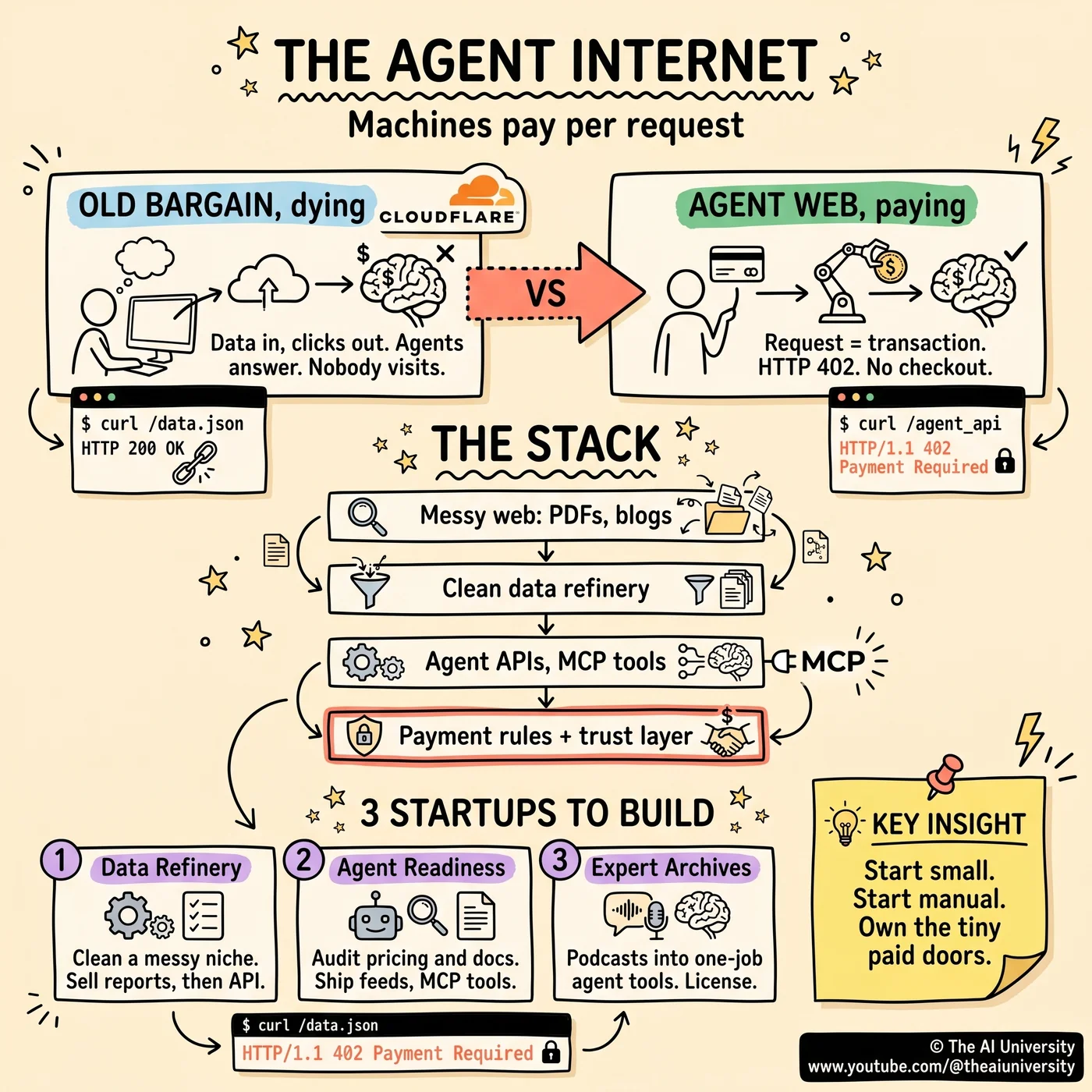
The arrangement was implicit but everyone understood it. You published; search engines indexed; readers arrived; some of them converted. Your data was the payment and traffic was the return.
Agents do not honour that trade, and it is not malice — it is just what they are for. They read the answer and leave. The information is consumed, the value is delivered to the end user, and the audience never arrives at your site at all.
That leaves publishers with a real problem and a real question. If the traffic is not coming back, what exactly are you being paid for?
2. Agents treat the web as infrastructure
The mental shift that makes everything else make sense: an agent is not a reader. It is a client.
Agents request data, comparisons, APIs and tools, and then pay tiny fees for them. They are not browsing; they are calling. And critically, humans refuse micro-payments per page. Machines pay without blinking.
That single asymmetry is the whole opportunity. Every attempt to charge humans a few cents per article has failed on friction — nobody wants a decision at every click. A machine has no such objection. The transaction is a line in a budget it was given, and it does not experience the decision as annoying.
3. HTTP 402 is the new checkout
The plumbing has two halves.
AI crawl control lets you see, allow or block every AI crawler individually. That alone is a change in position — you go from being read by default to deciding who reads you.
Pay-per-crawl answers the rest with HTTP 402 Payment Required, a status code that has sat in the spec for decades waiting for a use case. The crawler asks; you answer with a price; it pays and gets the content.
What makes this different from every previous paywall: no account, no cart, no invoice. The request is the transaction. There is no signup flow to abandon because there is no signup.
4. The stack behind the future
Any business built here has the same three layers, in the same order.
- Messy inputs first: PDFs, pricing pages, blogs, changelogs. The world’s useful information mostly lives in formats that were designed for human eyes.
- A refinery that turns them into clean, structured, dated records. Dated matters — a record without a timestamp cannot be trusted by anything making a decision.
- Agent-readable delivery: APIs, MCP tools, payment rules, trust signals.
Most people jump to the third layer because it is the technical one. The value is concentrated in the second: refining messy inputs into structured, current records is the hard part, and it is the part nobody can copy overnight.
5. Idea one — the niche data refinery
Pick a niche where valuable information is fragmented and changes weekly. Fragmented and weekly are both load-bearing: fragmented means no one has aggregated it, and weekly means the aggregation has to be maintained, which is a moat.
Example: med spas. Track prices, reviews, hiring and offers across a market, then sell the resulting reports to agencies who need to know what competitors charge and who is expanding.
Start manual, in a spreadsheet. That is not a compromise — it is how you find out whether anyone will pay before you build anything. Grow into an API and pay-per-use once the demand is proven and the manual work becomes the bottleneck.
6. Idea two — agent readiness
Every company on the internet is about to discover that agents read their site badly, and almost none of them will know why.
The service: audit a company’s pricing, docs and FAQs the way an agent reads them — not the way a designer intended them. Information buried in an image, a price that only appears after three clicks, an FAQ that contradicts the pricing page.
Then fix it. Correct the stale or hidden information, and ship structured files, feeds and MCP endpoints so the correct answer is retrievable rather than inferable.
The commercial path is the standard consulting ladder: sell the audit first, then monthly reporting, then software. Each rung funds the next and de-risks it.
7. Idea three — expert archives as tools
Experts sit on archives they have never monetised: podcasts, videos, blogs, client notes. Years of accumulated judgement stored in formats nobody can query.
The play is not to build a chatbot over the archive. It is to tag it deeply and ship one focused workflow per tool — a single job, done well, with a clear input and a clear output.
A cold email critic. An idea validator. One thing each, sold by subscription or licence.
Narrow beats broad here for the same reason it does everywhere: a tool that does one job is evaluable. A tool that does everything is impossible to judge and therefore impossible to trust.
8. The four questions to ask
If none of the three ideas above fits, these four questions will generate your own:
- What decision is expensive? Value concentrates where being wrong costs money.
- What information is messy and changes often? Messy means nobody has done it; changing means it has to be maintained.
- Who already pays for help? An existing budget is worth more than an obvious need.
- What can agents do better than humans? That is where the demand will actually come from.
The master formula
- Messy data = the raw material.
- Structure = what makes it usable.
- Payment = what makes it a business.
- Trust = what makes them come back.
You do not have to wait for the infrastructure to finish being built. Start manual, start small, and own the tiny paid doors agents use all day.
Frequently asked questions
What is the agent internet?
It is the web as agents use it: not pages to browse but infrastructure to call. Agents request data, comparisons, APIs and tools and pay small fees per request, rather than arriving as an audience that might buy something later.
What is HTTP 402 pay-per-crawl?
HTTP 402 is the “Payment Required” status code. Cloudflare’s AI crawl control lets you see, allow or block each AI crawler, and pay-per-crawl answers the rest with a 402 — the crawler pays for the request and receives the content. There is no account, cart or invoice: the request itself is the transaction.
Why can you charge agents when you could never charge humans?
Friction. Humans refuse micro-payments per page because every click becomes a decision. Machines pay without blinking — the fee is a line in a budget they were given, not an interruption.
What businesses can you start on the agent internet today?
Three from this article: a niche data refinery that tracks fragmented, weekly-changing information and sells structured reports; an agent-readiness service that audits and fixes how a company’s pricing, docs and FAQs read to an agent; and expert archives turned into single-purpose tools sold by subscription or licence.
Do you need to build the infrastructure first?
No. Start manual — a spreadsheet is a valid version one, and it tells you whether anyone will pay before you build anything. Grow into an API and pay-per-use once demand is proven and the manual work becomes the bottleneck.
Build it yourself
Everything written about here gets built in the open — the whole application, on camera, including the parts that did not work first time.
Keep reading
 AI agent skills
AI Agent Skills: 9 Free Ones and the Step Most Skip
AI agent skills install from one pasted link — that part is easy. The step that makes them genuinely useful is the one almost nobody runs.
Read article→ Jev decision model
Jev Decision Model: The AI That Can't Write, Only Decides
The Jev decision model can't write a word. Vercel and LangChain added it anyway. Why a "System One" classifier is 200x faster than the LLM in your agent.
Read article→ open source SaaS alternatives
Open Source SaaS Alternatives: 5 Repos Worth Selling
Semrush charges $250. This costs ten.
Read article→