
7 Zero-Investment AI Startup Ideas (Rated 8.5 to 10)
The best AI startup ideas start where the manual work is. Seven zero-investment builds rated 8.5 to 10, from a self-running agency to a Glassdoor for VCs.
The best AI startup ideas start where the manual work is. Not where the technology is interesting — where somebody is currently doing something tedious, repeatedly, by hand, and would rather not.
That gap is where seven zero-investment businesses are hiding. Zero investment is not a gimmick here; it is a constraint that forces the idea to be good. If you cannot start it with a laptop and a niche, it probably depended on capital rather than insight.
Seven ideas. Every one rated. Here is the full breakdown.
The short version
- Niche = the filter. AI = the team you do not hire.
- Outreach = the revenue. Zero investment = the point.
- Every idea below replaces hours of manual work that somebody is currently paying for.
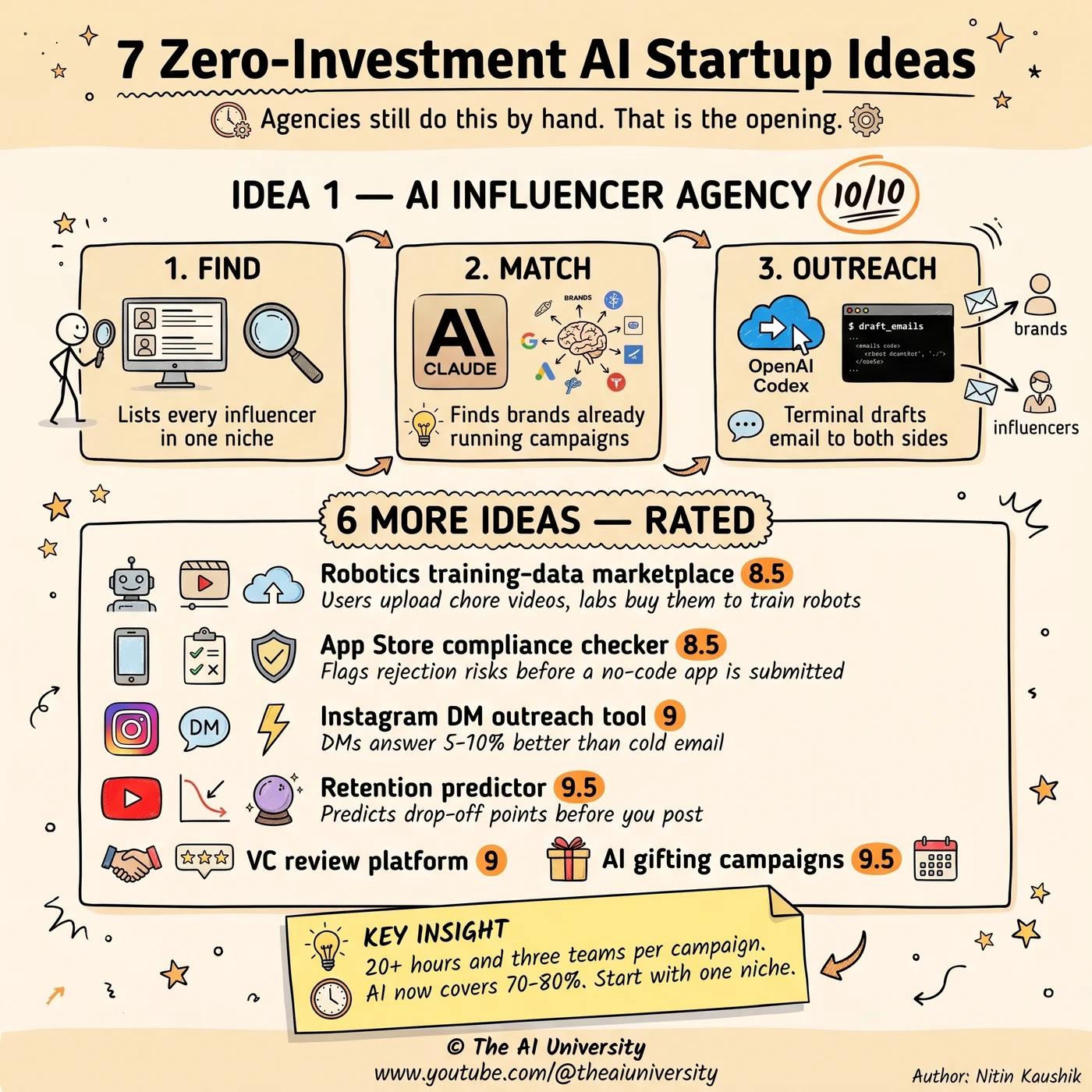
1. AI influencer agency — 10/10
The highest-rated idea here, and the one with the least novel technology, which is not a coincidence.
Claude Code or Codex finds the influencers, finds the brands, and drafts the outreach to both sides. What used to be three separate functions — research, matching, and outreach — collapses into one operator with a laptop.
The scale of the replacement is what earns the 10: it replaces three separate teams and 20+ hours per campaign. That is not an efficiency gain, it is a change in what one person can run.
Start with one niche. Influencer matching is only valuable when you understand the category well enough to know which pairings make sense, and that understanding is per-niche.
2. Robotics training-data marketplace — 8.5/10
Users upload videos of themselves doing household chores. Robotics labs buy them to train physical AI systems that need to learn what ordinary human movement looks like in ordinary rooms.
Structurally it is a two-sided marketplace taking 15–20% commission, targeting labs building physical AI.
The 8.5 rather than a 10 reflects the usual marketplace difficulty: both sides have to arrive, and neither is useful without the other. The upside is that the buy side is small, identifiable and well funded, which is the easier version of that problem — you can name every lab worth selling to.
3. App Store compliance checker — 8.5/10
A very specific, very painful problem: over 200 guidelines reject most no-code iOS apps on the first submission.
Every rejection costs a review cycle, and the developer usually has no idea which of the 200 rules they broke until Apple tells them. The product flags the likely rejection points before the developer ever submits.
What makes this a good candidate: the pain is acute, recent and repeated. Someone who has just been rejected will buy immediately, and the wave of no-code app builders means the affected population keeps growing.
4. Instagram DM outreach tool — 9/10
The insight is a channel arbitrage. DMs typically see 5–10% higher open and response rates than cold email, because the inbox is less crowded and the format feels personal by default.
The tool scales that outreach for D2C brands, agencies and freelancers — the three groups that live on Instagram commercially and currently do this by hand.
And the addressable channel is enormous: two billion users sitting there. The play is not to invent demand but to make an existing manual behaviour repeatable.
5. Retention predictor — 9.5/10
One of the two highest-rated after the agency, and for a good reason: it attacks the metric that actually determines outcomes.
The product reads a creator’s past videos and predicts the drop-off points before they post. Then it suggests the edits that lift retention.
Retention is what drives reach on every major platform. A tool that improves it is not a convenience — it is direct leverage on the creator’s income. That is the kind of value that makes pricing easy and churn low.
6. VC review platform — 9/10
Glassdoor for VC firms. Founders leave verified, anonymous reviews of how they were actually treated — during diligence, after a term sheet, and after a no.
Verification is the hard part and the whole product: verify with email, calendar invites or cap table docs, so a review carries weight rather than being anonymous noise.
One explicit caution: watch the legal side carefully. Publishing reviews of named firms by anonymous authors is a category with real exposure, and the verification process is as much a legal safeguard as a quality one.
7. AI gifting campaigns — 9.5/10
The observation is simple and true. Cold emails to executives get ignored. A personalized gift and note does not.
The product picks who to gift, what to send, and runs the whole process end to end — the research, the selection, the note, the logistics.
This is a proven category already, which is what earns the 9.5. You are not betting on whether corporate gifting works as an outreach channel; you are betting on being able to run it with AI at a fraction of the current operational cost.
The formula
- Niche = the filter.
- AI = the team you do not hire.
- Outreach = the revenue.
- Zero investment = the point.
Read back across the seven and the same shape appears every time: a specific niche, a task currently done by hand, and outreach as the thing that converts the capability into money. None of them required capital. All of them required picking one narrow group of people and understanding what they already pay for.
Frequently asked questions
What makes an AI startup idea zero-investment?
It can be started with a laptop and a niche, because the cost that used to require capital — a team doing manual research, matching or outreach — is the part AI replaces. Every idea above targets work somebody is currently paying humans to do by hand.
Which idea is rated highest, and why?
The AI influencer agency, at 10/10. Claude Code or Codex handles finding influencers, finding brands and drafting outreach to both, replacing three separate teams and more than 20 hours per campaign. Start with a single niche.
Why is Instagram DM outreach better than cold email?
Response rates. DMs typically see 5–10% higher open and response rates than cold email, and the channel has two billion users. The opportunity is packaging a manual behaviour that D2C brands, agencies and freelancers already perform.
What is the risk in building a VC review platform?
The legal exposure of publishing anonymous reviews of named firms. Verification — by email, calendar invites or cap table documents — is both what gives reviews credibility and what protects the platform, so it has to be built carefully from the start.
Why do retention predictors and gifting campaigns rate so highly?
Both attach directly to money. Retention is what drives reach, so predicting drop-off before a creator posts is direct leverage on their income. Corporate gifting is already a proven outreach category, so the bet is on running it more cheaply rather than on whether it works.
Build it yourself
Everything written about here gets built in the open — the whole application, on camera, including the parts that did not work first time.
Keep reading
 open source SaaS alternatives
Open Source SaaS Alternatives: 5 Repos Worth Selling
Semrush charges $250. This costs ten.
Read article→ Claude AI side hustles
Claude AI Side Hustles: 5 That Fit Around a Full-Time Job
Claude AI side hustles work because your job already gave you the niche. Five that fit around full-time work, and the one thing that decides all five.
Read article→ agentic AI system design
Agentic AI System Design: 9 Layers That Break in Production
Agentic AI system design is backend engineering, not prompting. The nine layers that decide whether your agent survives production.
Read article→