
SaaS Customer Acquisition: 12 Tested Ways to Get Your First Users
SaaS customer acquisition kills more apps than bad code ever will. Twelve tested channels, and the three-month grind most founders quit before.
Most SaaS apps do not die because the code was bad. They die because nobody ever showed up. The founder shipped, posted once, waited, and slowly stopped opening the analytics tab. SaaS apps die with zero customers, not zero code.
That is the uncomfortable asymmetry of building software today. Everyone teaches features and landing pages. Almost nobody teaches customer acquisition — the unglamorous, repetitive, months-long work of putting the product in front of people who have the problem it solves.
So here are twelve tested ways to get your first SaaS users. Every single one has produced real customers for real products. None of them is a growth hack. All of them are work.
The short version
- Your first users come from only three places: audiences you build, audiences you borrow, and search you earn.
- Eleven of the twelve channels below pay out in weeks. One — SEO — pays out in months and then keeps paying.
- The failure mode is almost never picking the wrong channel. It is quitting a channel in month two.
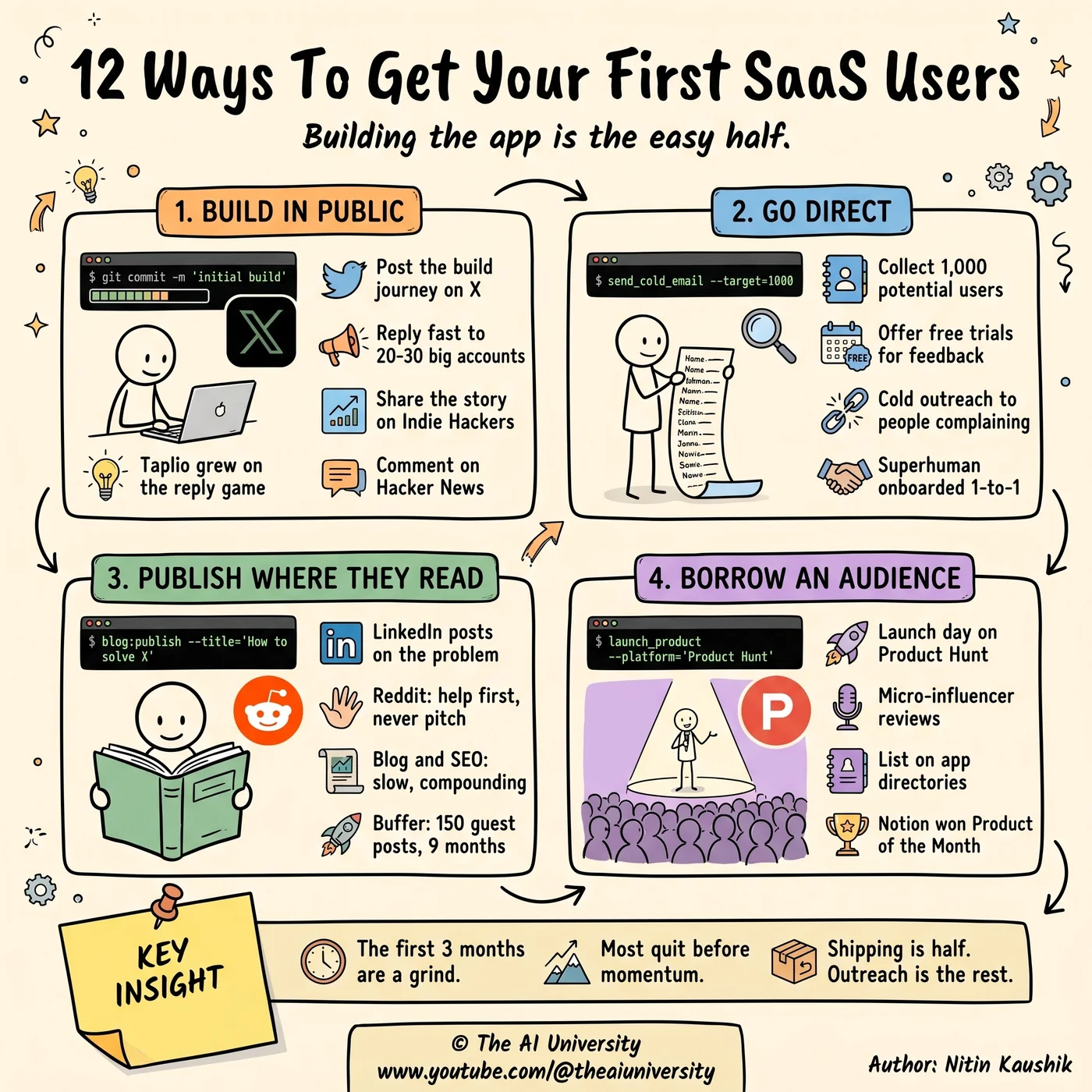
1. Build in public on X
Building in public means posting the progress, the new features and the hurdles as they actually happen — not a polished retrospective once the product is finished. The screenshots, the bug that ate a weekend, the metric that moved, the metric that did not.
What makes it work is not the content. It is the sequencing. Trust compounds, and the audience arrives before the product is ready. By the time you have something to sell, a few hundred people already know what it is, why you built it, and what problem it solves for them. Launch day stops being a cold start.
The practical version: post small and often rather than long and rarely. A single screenshot with one sentence of context is a post. So is a decision you reversed.
2. The reply game
You do not need an audience to reach one. You need access to somebody else’s.
Pick 20 to 30 US accounts your buyers already follow and turn notifications on for every one of them. Then reply — quickly, usefully, and without pitching. The first thoughtful reply under a post with thousands of readers gets seen by all of them.
Taplio built its early traction by replying faster than anyone else. Not by posting more. By being the most useful comment under other people’s posts, consistently, for long enough that people started clicking the profile.
3. The 1,000-user DM method
This is the least scalable thing on this list, and that is exactly why it works. Collect 1,000 prospects — Claude can do the finding and the qualifying — and then message every single one personally.
Personally means referencing something specific: what they build, what they posted, what they complained about last week. A thousand copy-pasted messages is spam. A thousand messages that each prove you looked is a business.
Superhuman onboarded its earliest users one at a time, by hand. One of the most premium products in email did its first customers through individual, human conversations. Doing things that do not scale is not a slogan; it is a stage.
4. LinkedIn for US reach
LinkedIn’s distribution is unusually generous to accounts with almost no followers, and its audience skews towards exactly the people who expense software.
The rule that decides whether it works: post about the problem your product solves, not the product. Nobody shares a feature announcement. People share the articulation of a problem they have been unable to describe.
And do not chase reach for its own sake. A small relevant audience beats a large irrelevant one — a hundred operations managers who have your exact problem are worth more than ten thousand people who found the post entertaining.
5. Reddit, without pitching
Your buyers are already on Reddit, describing your product’s problem in their own words, at length, for free. Find those subreddits and answer questions in them.
The mechanic is brutal and simple: promote once and you are finished there. Reddit communities detect and eject marketing with unusual speed, and the damage is hard to undo. So the only viable strategy is to be genuinely useful for a long time and let people find the product through your profile.
Slow, but the trust transfers. A recommendation inside a subreddit carries weight no ad placement does.
6. Product Hunt launch day
Product Hunt is not a traffic source you can arrive at cold. It rewards momentum in the first hours, which means the launch is decided before the launch.
Line up early free users in advance and make sure they show up on launch morning. Tell them the date. Remind them the night before. The initial cluster of engagement is what gets the listing in front of everybody else.
It still works for exactly the kind of product that reads well in a screenshot. Notion won Product of the Month there back in 2016 — a reminder that the platform has been producing early adopters for a decade.
7. App directory listings
The least exciting item here and the one with the best effort-to-return ratio. There are hundreds of software directories, niche roundups, alternative-to pages and category listings that will take your product for free.
List everywhere. Each listing is a backlink and a small stream of organic reach, and it is done once and paying forever. Block out an afternoon, work through a list, and stop thinking about it.
8. Indie Hackers journey posts
Indie Hackers is one of the few places where the build story is the content, and where the readers are disproportionately early adopters, other founders and people who will actually try a new tool.
Post the build story where early adopters go looking for one. What you tried, what did not work, what the numbers actually are. The audience there rewards specificity and is allergic to vagueness.
9. Hacker News comments
A Hacker News launch post is a lottery. A Hacker News commenting habit is not.
Comment usefully on threads adjacent to your problem space and technical buyers find you without a launch. The profile field is a link. Engineers who read a genuinely informed comment click it far more often than they click an ad.
10. Intent-based cold outreach
Cold outreach fails when it is untargeted. It works when the recipient has publicly stated the problem in the last week.
Use AI to find people posting the exact complaint you solve — the forum thread, the frustrated post, the review of a competitor. Then write one message that references their actual post.
The difference is not the tooling. It is that the message could only have been written to them, which is the single variable that moves reply rates.
11. Partner with micro-influencers
Large creators price themselves out of a pre-revenue budget. Small niche creators do not.
Look for creators with small, tightly-defined audiences, ask for a real review rather than a scripted read, and expect prices a founder can actually pay. A genuine walkthrough from someone a niche trusts converts at rates a paid ad never reaches.
12. Passive SEO traffic
This is the slowest channel on the list and the only one that keeps paying after you stop.
Buffer ran 150 guest posts in nine months to over 100,000 users. That is the shape of the channel: a large, boring, front-loaded investment that produces compounding traffic long after the work is done.
If you can only afford to run one long game alongside the eleven short ones, run this one — but understand that you are planting, not harvesting.
The part most people miss
Every one of these twelve channels is known. None of them is secret. What separates the founders who get customers from the ones who do not is the calendar, not the channel.
- Build is the easy half.
- Distribution is the hard half.
- Months one to three are the grind — the part where nothing visible happens.
- Most founders quit right there.
The channels do not fail. The three-month commitment fails. Replies do not compound in week two. Guest posts do not rank in week two. DMs do not turn into a pipeline in week two. All of it works in month four, which is a month most people never reach.
Commit to all twelve for three months. If you still have no customers, email me and I will buy your first subscription.
Frequently asked questions
How do you get your first SaaS customers with no audience?
You borrow one. The reply game, Reddit answers, Hacker News comments and micro-influencer partnerships all put you in front of an audience somebody else already built. The 1,000-user DM method skips audiences entirely and goes person by person. Building your own audience — build in public, LinkedIn, SEO — runs in parallel and pays later.
How long does SaaS customer acquisition take to work?
Plan for three months of visible nothing. Months one to three are the grind, and that is where most founders stop. Eleven of the twelve channels above start producing inside that window if they are run consistently; SEO takes considerably longer and then compounds.
Which acquisition channel should a solo founder start with?
Start with the channels that require zero audience and zero budget: the reply game, Reddit, Indie Hackers and directory listings. Add build-in-public immediately, because it is the one that makes every later channel cheaper. Add SEO once something is working, because it is the only one that keeps paying.
Is cold outreach still worth doing for SaaS?
Yes, when it is intent-based. Cold messages to a scraped list do not work. Messages to people who publicly described the exact problem you solve, referencing their actual post, do — because the recipient can tell the message could not have been sent to anyone else.
Do you need to launch on Product Hunt?
No, but it is a strong one-day spike for products that demo well in a screenshot. The outcome is decided before launch day by how many early users you have lined up to show up in the first hours.
Build it yourself
Everything written about here gets built in the open — the whole application, on camera, including the parts that did not work first time.
Keep reading
 AI agent skills
AI Agent Skills: 9 Free Ones and the Step Most Skip
AI agent skills install from one pasted link — that part is easy. The step that makes them genuinely useful is the one almost nobody runs.
Read article→ Jev decision model
Jev Decision Model: The AI That Can't Write, Only Decides
The Jev decision model can't write a word. Vercel and LangChain added it anyway. Why a "System One" classifier is 200x faster than the LLM in your agent.
Read article→ open source SaaS alternatives
Open Source SaaS Alternatives: 5 Repos Worth Selling
Semrush charges $250. This costs ten.
Read article→