
Product-Market Fit Isn't Code: 5 Apps That Won on Distribution
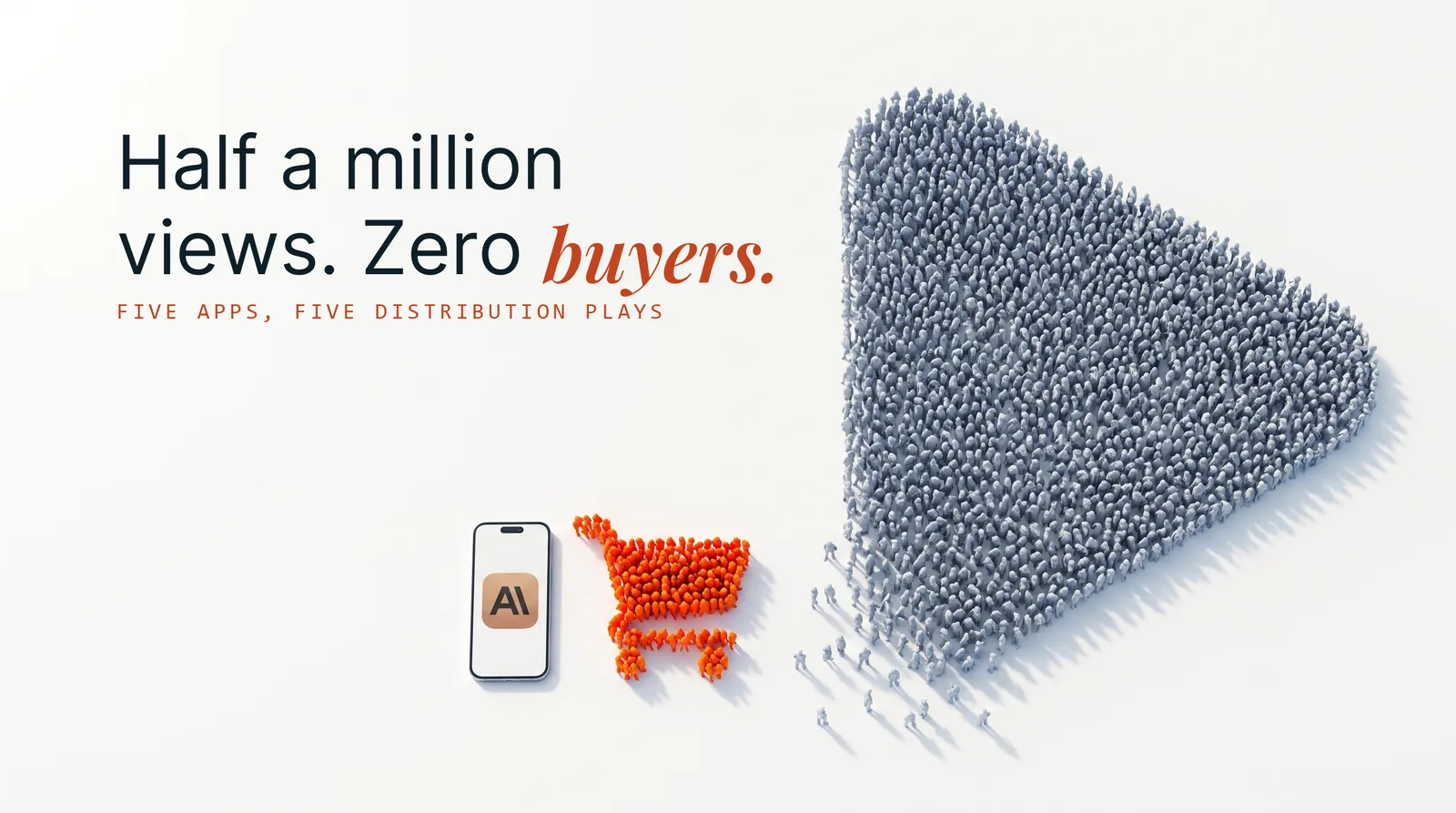
Product-market fit failed a 500,000-view launch and rewarded a 40,000-view one. Five real apps, five distribution plays, and one that traded equity for buyers.
Most founders build the product and skip the hard part. The hard part is not shipping. It is finding the specific group of people who will pay, and getting in front of them repeatedly enough that some of them do.
Product-market fit gets talked about as though it lives in the product. In practice it lives in the overlap between what you built and who saw it — and the second half is the one nobody rehearses. A launch can reach half a million people and convert nobody, while a smaller one reaches forty thousand and produces customers on day one.
Here are five real apps that figured this out, five different distribution plays, and one uncomfortable lesson underneath all of them.
The short version
- Not one of these five apps won on features.
- Views are vanity. Buyers are distribution. They are not the same audience and they rarely overlap.
- Every play below is a different answer to one question: whose attention already exists, and how do I get in front of it?
1. The right users beat big views
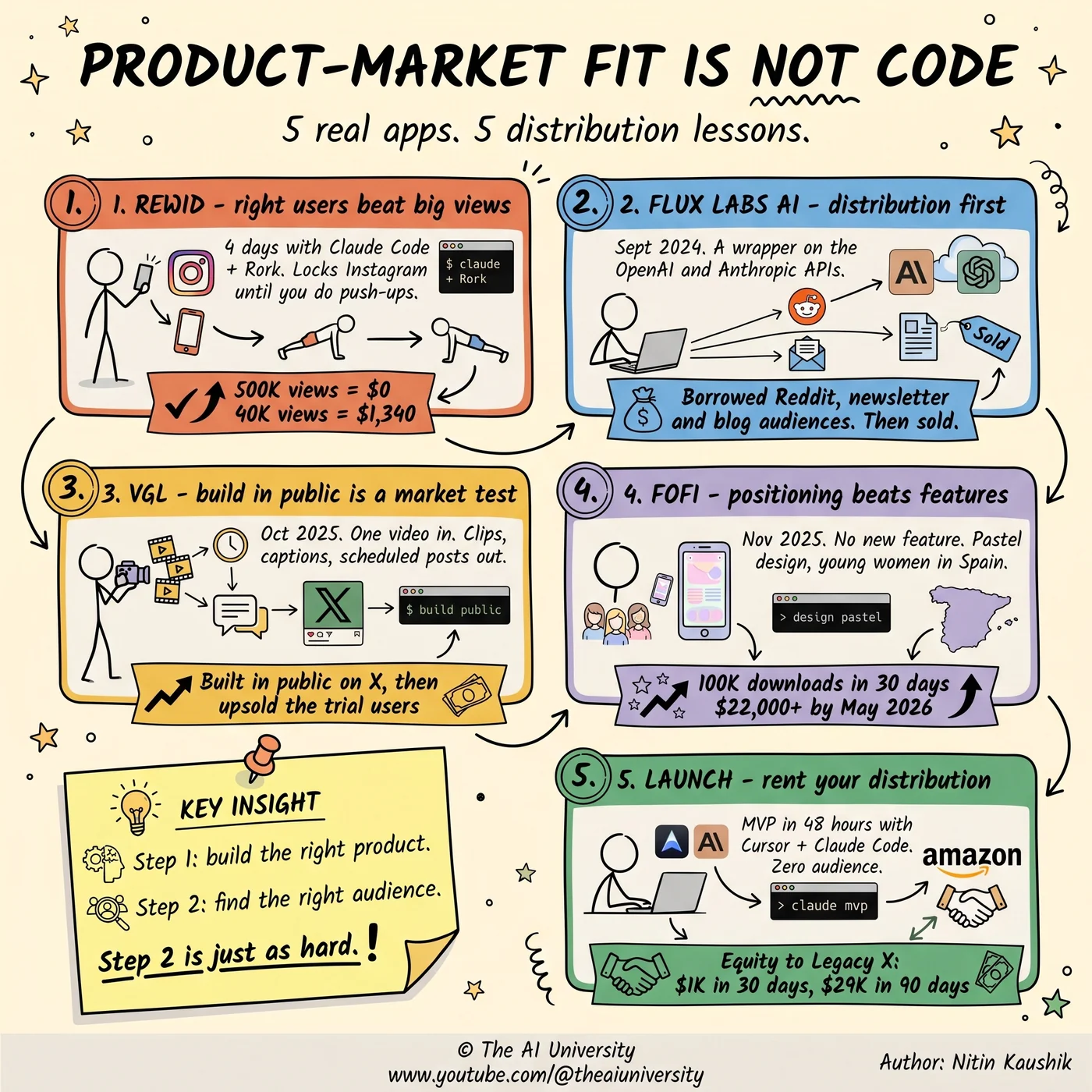
Rewired was shipped in four days by a 17-year-old using Claude Code and Rork. The app locks your Instagram until you finish push-ups or a walk — a simple, physical constraint on a habit people say they want to break.
Two reels went out. One did 500,000 views. The other did 40,000. The 500K reel is the one that looks like success on a screenshot, and it is the one that produced nothing: it reached kids. The 40K reel reached people who pay.
That gap is the entire lesson of this post compressed into two numbers. Reach is a measure of how many people saw it. Distribution is a measure of how many of the right people saw it. A channel that reliably delivers the second is worth more than one that occasionally delivers ten times as much of the first.
The practical takeaway: when a piece of content goes wide, do not celebrate the number. Go and look at who it reached. If they are not buyers, the reel was entertainment, not marketing.
2. Distribution before the product
Flux Labs AI launched in September 2024 as a wrapper on the OpenAI and Anthropic APIs. On the feature axis, that is about as thin as a product gets — the underlying capability was available to anyone with an API key.
The founder did not compete on the product. He borrowed Reddit threads, newsletters and blogs that already had readers, and put the wrapper in front of audiences somebody else had spent years building.
Customers arrived before the product needed them. Then he sold it.
The mechanic here is worth naming, because it inverts how most people sequence a launch. The usual order is build, polish, then look for an audience. The order that works is find the audience, confirm they have the problem, then build the thinnest possible thing that solves it. Borrowed distribution is not a shortcut around product quality — it is a way of finding out whether the product needs to exist at all before you spend six months on it.
3. Building in public is research
Vugola AI launched in October 2025: one video goes in, and clips, captions and scheduled posts come out. The founder built it live on X, in public, while it was still incomplete.
Two things happened at once. First, the watchers converted — people following a build become the trial users of the finished thing, because they already understand what it does and why. Second, and more valuable: every reply was free research on what to build next.
That second effect is the one founders underrate. A public build turns the roadmap into a conversation. Instead of guessing which feature matters, you post the plan and read the objections. The people who reply are self-selected into caring, which makes their feedback worth more than a survey.
Building in public is usually filed under marketing. It is closer to continuous customer development that happens to also produce an audience.
4. Positioning can beat features
Flowfy launched in November 2025 into personal finance — a category with thousands of existing apps, most of which do broadly the same arithmetic.
There was no new feature. What there was: pastel design, and an audience aimed at squarely and unapologetically — young women in Spain. Not "everyone who wants to budget." One country, one demographic, one visual language that signalled this was made for you before a single feature was read.
The result: 100,000 downloads in 30 days, and over $22,000 in revenue by May 2026.
Positioning is the cheapest lever a solo founder has, and the least used. Narrowing the audience feels like giving up market, which is why most people refuse to do it. In practice it is the opposite — a specific audience gives you a specific channel, a specific visual language and a specific message, and all three make the marketing dramatically cheaper.
5. Rent distribution, do not build it
Launch Fast is an Amazon seller research tool whose MVP was coded in 48 hours with Cursor and Claude Code. The founder had a real problem, a fast build, and zero audience.
Rather than spend a year building one, he traded equity to Legacy X for instant access — a partner who already had thousands of Amazon sellers paying attention.
The outcome: thousands of Amazon sellers on day one. $1,000 in the first 30 days, $29,000 in 90.
This is the least romantic play on the list and often the most rational one. If somebody has already spent five years assembling exactly the audience you need, buying access to it — with equity, revenue share or cash — can be cheaper than recreating it. The question is not whether renting distribution feels like cheating. It is whether you can survive the years it would take to build your own.
The part most founders skip
Not one of these five won on features. Rewired was four days of work. Flux Labs was an API wrapper. Flowfy was a design direction. Launch Fast was 48 hours of code plus somebody else’s audience.
- Product is the easy half.
- Audience is the hard half.
- Views are vanity.
- Buyers are distribution.
- No distribution, no business.
Building the right product is step one. Finding the right audience is step two, and it is just as hard — with the added difficulty that it cannot be done alone at a keyboard, which is precisely why technical founders avoid it.
Frequently asked questions
What does product-market fit actually mean if it is not about features?
It is the overlap between what you built and the specific people who will pay for it. All five apps above had ordinary products; what differed was how precisely they identified and reached the buying audience. A product with no distribution has no way to discover whether it fits anything.
Why did a 500,000-view reel produce fewer customers than a 40,000-view one?
Because the audiences were different. Rewired’s 500K reel reached kids, who do not pay. The 40K reel reached people who do. Reach measures how many people saw something; distribution measures how many of the right people saw it.
How do you get distribution with no audience of your own?
Borrow or rent it. Flux Labs borrowed Reddit threads, newsletters and blogs that already had readers. Launch Fast traded equity to a partner for instant access to thousands of Amazon sellers. Both reached buyers on day one without spending a year building a following.
Is building in public a marketing tactic or a research tactic?
Both, and the research half is the underrated one. Vugola AI converted watchers into trial buyers, but every reply to the build posts was also free feedback on what to build next — a running conversation with the exact people who would use it.
Can positioning alone win in a crowded category?
Flowfy suggests it can. Personal finance has thousands of apps and Flowfy added no new feature — it added pastel design and a tightly defined audience of young women in Spain, and did 100,000 downloads in 30 days. Narrowing the audience is what made the marketing affordable.
Build it yourself
Everything written about here gets built in the open — the whole application, on camera, including the parts that did not work first time.
Keep reading
 AI agent skills
AI Agent Skills: 9 Free Ones and the Step Most Skip
AI agent skills install from one pasted link — that part is easy. The step that makes them genuinely useful is the one almost nobody runs.
Read article→ Jev decision model
Jev Decision Model: The AI That Can't Write, Only Decides
The Jev decision model can't write a word. Vercel and LangChain added it anyway. Why a "System One" classifier is 200x faster than the LLM in your agent.
Read article→ open source SaaS alternatives
Open Source SaaS Alternatives: 5 Repos Worth Selling
Semrush charges $250. This costs ten.
Read article→